

Value Creation and Competitiveness in Small European Markets

Co-Authors








Statement of Originality
This deliverable contains original unpublished work except where clearly indicated otherwise. Acknowledgement of previously published material and of the work of others has been made through appropriate citation, quotation, or both.
Disclaimer
The European Commission’s support for the production of this publication does not constitute an endorsement of the contents, which reflect the views only of the authors, and the Commission cannot be held responsible for any use which may be made of the information contained therein.
Introduction: Identifying Strategies to Improve and Maintain Competitiveness
1.1 Orientations and competitiveness factors of small markets
In previous research, we have identified four key avenues employed by small film ecosystems to compensate for the lack of economically viable home markets. These four, production services, cultural resonance, exports, and cinematic arts, can be understood as strategies to achieve competitiveness at a very fundamental level. Due to its empirical basis, we have referred to this as the Small European Film Ecosystem Model (SEFEM). It is very likely, however, that it will have explanatory power beyond small European film markets. The avenues can be distinguished from each other on the basis of a number of parameters including the underlying financing logic, the legitimacy and success criteria of each avenue as well as the primary policy fields that inform each avenue. The latter is understood from a functional rather than an institutional perspective. In other words, both the underlying legal framework and the administration of production incentive schemes may fall under the jurisdiction of ministries of culture or national film institutes, but are not, for that reason, regarded solely as a cultural policy matter. While all four orientations are theoretically open to all markets, contextual factors influence feasibility. For example, successful circulation on Video-on-Demand (VoD) platforms is difficult where domestic VoD penetration is low. Drawing on the ecosystem model, we have in Crescine examined how films face very different challenges in distribution, relations to global VODs, and reception, depending on what kinds of success they aim for.
This deliverable builds on the work to outline how the levels of competitiveness and challenges to increase competitiveness are also dependent on the orientation of the industry and the aims of any given project or initiative. Across the four avenues we find that a key challenge is that small film industries are susceptible to volatility from both external and internal changes and are in most cases highly dependent on factors they have limited impact on.
Although all Crescine markets are small, they range from 1.3 million in Estonia to 10.7 million in Portugal and 11.8 million in Belgium, of which Flanders accounts for 6.7 million. While this means that none of the markets are large enough to sustain an industry on the domestic market alone, the actual and potential financial contribution from domestic audiences varies significantly. As the figure above shows, the total box office of Denmark and Ireland outrank the larger Portugal, due to higher admissions per capita and higher average ticket prices. This comparison indicates that some markets might have an untapped potential, but it also sets some hard limits. Portugal, with the admissions per capita of Ireland, would have a total box office to rival that of the Netherlands. Yet the Estonian total box office would still be a third of the current Portuguese if they had the highest admissions per capita and the highest ticket prices in all of Europe. Market size is also a limiting factor when it comes to most established risk reduction strategies, such as high production volume, which contributes to high fluctuation in market shares from year to year.
The transnational nature of the European film industries also gives an advantage to high-cost countries. While production in Denmark is expensive, Danish films can reduce costs by shooting in lower-cost countries and still get the benefit of high ticket prices in the home market. Population size and GDP also impact the levels of public funding available, reinforcing the dynamics of the marketplace.
Domestic market shares have traditionally been used as an indicator of industry strength and to legitimize public funding of film production. One example is the current Danish film policy, which was largely established in the late 1990s in part as a response to a period of falling domestic market shares in the first part of the decade. High domestic market shares have also proven to increase stability during periods of instability in the global industry. As illustrated by the figure above, most small EU film industries also find most of their audiences in the home market.
Domestic admissions remain a key measure of cultural resonance success, yet not all films produced within this orientation are aimed at large audiences. However, all films produced within the cultural resonance orientation have cultural specificities that limits their exportability and increase their connection to local audiences. For titles that do aim for large audiences this becomes a strength in head-to-head competition with US productions. While Hollywood and other foreign productions remain a competitor for screens, prominence, and attention, local films can address audience demands in ways that foreign productions cannot or will not. The case of small market comedies illustrates this point (Bengesser & Nielsen, 2024). Crescine’s audience research has found that comedy films provide cultural resonance through perceived local idiosyncrasies and social connection about these perceived national specificities achieved when domestic comedies manage to draw a crowd (Gracio et al., 2025).
As cultural resonance-oriented films are aimed primarily at a domestic audience they are heavily dependent on the domestic infrastructure. The capacity of local cinemas limits the economic potential of films aimed at domestic audiences (see chapter 4), and without strong and committed local distributors (see chapter 5) it can be challenging to exploit the domestic potential fully. Especially if the interests of these are mainly aligned with Hollywood and other foreign entities. The challenge of infrastructure also extends into the national film discourse. If audiences are to select local films instead of heavily marketed global blockbusters, they need to be aware that these films exist and how they speak to them (see Damasio & Bengesser, 2024). Finally, domestic audiences are also diverse in age, taste, and so on, and it is a challenge for small film industries to produce and market enough films to cover a wide range of audiences.
All of this combines to making the cultural resonance orientation the “expensive” option. To be successful, the industry needs to produce a relatively high number of titles with competitive budgets and be supported by an infrastructure that is also unlikely to be economically viable without some form of public support
The export orientation’s greatest challenge is facing up to US productions and films from other large markets in direct competition. These titles compete for attention, screens, access to, and visibility on VoD services. In this fight, the small market films face several challenges. While the exports-oriented titles from smaller markets have comparatively large budgets compared to other small market films, these budgets are dwarfed by their competitors from the US and the larger European markets. Export-oriented films are also dependent on being able to enter foreign markets. This makes them dependent on numerous external factors that can limit their competitive ability, such as distributors, sales agents, local competition and even regulations that limit imports or specify release windows.
From the Crescine research, we find that the small market films that are most successful in achieving international admissions tend to have high narrative transparency and try to limit the cultural discount by avoiding cultural specificity. While this can increase the global appeal of individual small market films, it also makes them replaceable by competing titles from elsewhere. Export-oriented films from small markets must therefore contend with rarely being the preferred choice among audiences given the choice between a small market film, a large market film with higher financial resources, or a domestic film with a more specific appeal.
From the Crescine markets, we see that producers and distributors address this competition by finding international release dates that limit direct competition. The most successful titles have also spotted underserved audiences, but there is also a risk of trend-chasing. Belgian nWave is perhaps a prime example of both. Their first feature-length animated film was released in 2008, in a year when 62 animated feature films were released in Europe. By the time their latest film was released in 2023, the competition had increased dramatically as 235 animated feature films saw a European release. The increased output of fiction films in Europe has, in the post-COVID years, been accompanied by a significant drop in the number of European films that reach more than 1 million non-national admissions (EAO 2025, p. 18). nWave has similarly seen a marked decline in the number of non-national admissions to their films compared to releases prior to 2020 (Nielsen, 2026). While nWave’s international success is extraordinary among Crescine production companies, this also illustrates that the export orientation is a high-risk game.
While nWave is a prime example of exports as a selective strategy, we also find evidence of structural aspects within industries that help or hinder exports. Ireland is the prime example of a market where, due to a combination of language, a highly transnational industry, a successful incentive scheme, and a low domestic market share, producing for export becomes a baseline. Denmark, on the other hand, sees relatively high international admissions but mainly for films that still get significant admissions domestically. As such, the exports could to some extent be described as a byproduct of a strong national industry.
Another structural aspect that warrants further examination is the role of distributors, including the presence of local branches of the major Hollywood studios, as shown in Figure 1.3. There are local subsidiaries of major US distributors in six of the 16 small EU film markets, and these are the six markets with the highest average exports per title. These subsidiaries rarely release domestic films, and it is therefore unlikely that they contribute directly to higher exports. However, the correlation points towards some industries being more connected to the global film market than others on a fundamental level.
Films produced within a cinematic arts orientation face the highest levels of competitiveness. For films with ambitions to reach international arthouse audiences, the top festivals can have a significant impact, but these are highly competitive. Further, within the most prestigious festivals, the awards often go to films from larger markets and with higher budgets. This should also be a reminder that while festival success is often used as an indication of “quality” and artistic innovation, it is, at best, a proxy, and that awards and nominations are also a result of networks and campaigns. As such, increasing competitiveness in the festival circuit does not necessarily equate to increasing the artistic quality of the movies and vice versa. Further, it also indicates that a strategy aimed at increasing the number of selections to top film festivals might not be the best strategy for increasing the number of awards at the same festivals.
Success, measured in awards and nominations, is also reliant on a small number of directors. Talent development must therefore be the cornerstone of any strategy to increase competitiveness for cinematic arts-oriented films. Yet talent can also easily move between industries. For example, the Danish-Iranian director Ali Abbasi has been selected for the Cannes festival on three separate occasions, with films from three separate majority-producing countries, and much of Ireland’s recent festival success is based on the films of the Greek director Yorgos Lanthimos. If an industry legitimizes its funding based on festival success, “losing” talent to other industries could therefore be a challenge.
Cinematic arts-oriented films also face significant competition in theatrical and VoD markets. They face direct competition with other cinematic arts-oriented films for an audience that might not give preference to local films over more widely acclaimed foreign titles. Outside specialized arthouse cinemas, they also face competition from both Hollywood productions and mainstream domestic titles, which typically have higher budgets and stronger marketing. These patterns are also present on VOD (see chapter 6).
1.6 Production services
The production services orientation positions an ecosystem in a highly competitive area. All European countries, except Luxembourg, have a form of incentive scheme to boost local production activities. While such schemes can function as indirect support for domestic films or counter runaway productions, most of them are also designed to attract foreign film productions. Many countries have attempted to increase the competitiveness of their countries as a shooting location by making the incentive schemes more financially attractive than those of their competitors. Some have argued that this creates a race to the bottom where countries try to undercut competing schemes to attract foreign productions. Regardless of such claims, the attractiveness of any given incentive scheme depends on legislation and incentive scheme design in otherwise comparable countries.
The alternative to competing on incentive schemes alone is to compete on below-the-line talent and facilities. Prospective productions can be swayed by better locations, facilities, and skills if the incentives are otherwise comparable. This requires long-term investments but can both increase competitiveness and reduce dependency on external factors. Still, there is a significant risk that such investments are not sufficient if other countries continue to offer more attractive terms, and the industry risks being left with unprofitable facilities and unemployed professionals.
On the other hand, underinvestment in facilities and development of below-the-line workers can lead to a situation where incoming productions outcompete domestic productions for these. Evidence from Crescine tells us that there is a benefit to be had for the local industry by striking the right balance.
1.7 Chapters in this report
Jaka Primorac and Jakob Isak Nielsen address the production service avenue. Their chapter, “Balancing acts: incentive scheme logics in small European film markets”, focuses on two very different production incentive schemes, the Croatian scheme established in 2012 and a completely new production incentive scheme that is to be launched in Denmark in the Spring of 2026. The chapter compares the schemes, discussing both their similarities and their different ambitions that speak to the schemes being incorporated into very different film ecosystems.
Judith Pernin’s contribution, The rise of Irish-language films: audience perception, competitiveness and cultural resonance in a bilingual screen industry (Chapter 3), addresses the issue of Irish-language films in Ireland. As a majority English-speaking country with a strong connection to the global film industry, Ireland has a competitive advantage when it comes to exports and production services compared to most other small European countries. This, however, also leads to a disadvantage in the domestic market as there is no protective language barrier, and much of the production is aimed at international audiences. By looking at the reception of Irish-language films in Ireland, Pernin finds that Irish-language films replicate patterns found in culturally resonant films in other markets. These films generally perform better in their home market than abroad, unless supported by festivals, and are viewed by a blend of skepticism and enthusiasm by local audiences.
Jakob Isak Nielsen (Chapter 4) and Marius Øfsti & André Rui Graça (Chapter 5) address the question of cinema and distribution infrastructure for domestic films, respectively. Jakob Isak Nielsen’s contribution, “The importance of cinema infrastructure in small film markets”, analyses the cinema infrastructure in Lithuania and Denmark. The article focuses on how cinema infrastructure impacts the cultural resonance-orientation evidenced in the funding and production infrastructure as well as the relatively high domestic market share in both ecosystems. A key component is the high domestic market share and overall admissions coming from cinemas in smaller cities in Denmark, whereas Lithuania is challenged by having extremely few cinemas in those cities. A case study of Southern Chronicles (LT, 2024) tests to which screenings in cultural centers and similar venues can compensate for the lack of such cinema infrastructure.
In “Domestic distributors and the competitiveness of domestic films in Denmark and Portugal”, Øfsti & Graça look at the two dominant distributors in Denmark and Portugal. They find that while Nordisk Film and NOS Lusomundo Audiovisuais share some key characteristics as major players in distribution and exhibition, they also differ in their relation their connectedness to the overall film industry. Where Nordisk Film is vertically integrated with both production and exhibition and highly ingrained in the Danish film industry, NOS Lusomundo is only integrated with exhibition and is more strongly tied to the telecom industry than the film industry. While this does not explain the differences in domestic market shares between the two countries, it demonstrates that key parts of the infrastructure for domestic films also have very different incentives to contribute to their success.
Chapter 6 by Cathrin Bengesser & Sten Kauber takes the case of two culturally resonance-oriented markets – Denmark and Estonia – to investigate the interrelations between market orientation, the theatrical performance of films and their domestic and international distribution on VoD. The chapter shows the interconnection between theatrical performance and VoD distribution. Domestic theatrical performance creates value and competition for the VoD window in cultural resonance markets, particularly if global SVoDs localize their offer to the tastes of domestic audiences, but the Estonian case highlights that this localization is limited for those (very) small markets that offer limited potential for global SVoDs. The chapter therefore emphasizes that a diversity of local VoD players with different remits is necessary to secure access to domestic film. It also shows that the theatrical export track record is crucial for a wide circulation of small market film on VoD. VoD distribution thereby reinforces orientation patterns prevalent in the market rather than challenging or reversing them.
Chapter 7 by Małgorzata Kotlińska and Marta Materska-Samek investigates “Collective Agility” as a characteristic of small markets that can be of competitive advantage, comparing Estonia, Flanders and Portugal. “Collective agility” is understood as the capacity of the entire system to survive and develop despite structural constraints. Hybridization in professional roles as well as film portfolios, ability to rapidly reconfigure resources and switching sectors, policy scaffolding and knowledge networks among professionals as well as networks with intermediaries (like festivals or VoD services) are introduced as factors that build resilience and competitiveness. At the same time, the chapter raises awareness of the costs and tradeoffs of collective agility that manifest differently across the three case countries.
1.8 Methodology
This report is built on the methodology and data collected for the report Small European Film Markets: Portraits and Comparisons, updated with 2023 data from the European audiovisual observatory and Eurostat. In addition, the data on films from the Crescine markets has been updated in several ways.
The selection of titles is now based on feature films in the Lumiere VOD database as well as Lumiere Pro to include non-theatrical films. The dataset has been assembled by taking all titles in Lumiere Pro or Lumiere VOD produced from 2014 to 2023 with at least one Crescine country among the production countries. Additional data has been added from TMDB using API access, including presence in VoD catalogs from JustWatch, and from the non-commercially available IMDb datasets. This data has been added to the Lumiere data using TMDB IDs. For titles where TMDB IDs were not included in Lumiere, these IDs were found using IMDb or Wikidata IDs in the Lumiere datasets if possible or by an R script to search TMDB using their API access and using data such as directors, production year, production country and so on to verify the potential matches.
All titles have also been assigned a Crescine “ecosystem”, based on the Lumiere practice of listing the majority producing country first. However, these are not always correctly assigned, and we have made efforts to correct any mislabeled titles. Several titles were manually identified as mislabeled previously and using additional data from TMDB we flagged an additional number of titles for manual checking in cases where the release dates, admissions, languages spoken and origin country of the companies most likely to be associated with the producers of the film indicated that the assigned first production country might be wrong. These titles were manually checked using sources such as the various film institutes to verify the majority producing country.
The final dataset includes only titles have been assigned a Crescine “ecosystem”, are labeled "movie" in Lumiere VOD and have a runtime of at least 65 minutes or labeled “feature film” in Lumiere Pro. This dataset, labeled "Crescine Features 2014-2023", consists of 2112 unique Lumiere IDs. Of these, 2037 and 190 respectively are missing a “tmdb_id” and therefore also missing any data from TMDB. The dataset includes the following columns:
lumiere_id (from Lumiere Pro or Lumiere VOD)
tmdb_id (see above)
ecosystem (see above)
original_title (from Lumiere)
production_year (from Lumiere)
directors (from Lumiere)
producers (from TMDB, “Producer” credits only, not “Executive Producer”, “Co-Producer” and so on)
languages (from TMDB, the first language is “origin_language” and subsequent languages are additional “spoken_languages”)
animation (from Lumiere, TMDB and IMDb, True or False with mixed included in True, titles with no genres listed as NA)
non_fiction (from Lumiere, TMDB and IMDb, True or False with mixed included in True and titles with no genres listed as NA)
genres (combined from IMDb and TMDB)
runtime (from IMDb or TMDB)
domestic_release date (from Lumiere, based on ecosystem)
domestic_admissions (from Lumiere, based on ecosystem)
export_admissions (from Lumiere, summarized all admissions from markets other than the domestic)
production_countries (from Lumiere)
no_theatrical_export_markets (from Lumiere, with some additional markets from TMDb. These additions do not have admissions. Number of nondomestic markets with a theatrical release)
prod_companies (from TMDB)
Data on VOD presences comes from JustWatch and was collected via the TMDB API on October 30th, 2025, with some titles added on November 28th, 2025. The data includes the name of the provider and the country where the title is offered, as well as the type of offer, rent, buy, flat rate, or free. This data covers 139 countries and 531 providers. Providers are not grouped by brand or company affiliation, for example Netflix, Netflix Kids and Netflix basic with ads are counted as separate providers.
For comparisons with other small EU countries, data has been drawn from the same sources but without additional TMDB or IMDb data, and no effort has been done to correct the first producing countries. Small EU countries are defined as countries with a population between 1M and 16M.
Balancing Acts: Incentive Schemes Logic in Small European Film Markets
By Jakob Isak Nielsen and Jaka Primorac
The global race to attract incoming productions has been going on for decades, and many countries around the world have developed different schemes to bring such productions to their shores. By using the case study of the Croatian and Danish production incentive schemes introduced in 2012 and 2026, respectively, this article critically assesses the impact of production avenue logics on small European film markets. When is the dual purpose of addressing the needs of the local film industry and the international film stakeholders out of balance? What are the intended and unintended (positive and negative) actions of the production service-avenue?
2.1 Introduction
Walking through international film markets like the Marché du Film in Cannes or the European Film Market in Berlin, it's evident from the different film commission booths and their billboards that the global race for film production is on. Posters highlight the availability of 25%, 30%, or even 60% production incentives for incoming productions, with or without additional logistical or other (national or local) film support. Europe is a highly active participant in these ‘incentive wars,’ and financing reports from EAO & EFARN demonstrate that these schemes play an increasingly large part in the financing mix of European film (Kanzler 2025, p. 92; Joliveau-Breney 2026, p. 96), particularly in films from larger markets.
With the production incentive scheme in Denmark, every country in the EU either has or has had an incentive scheme. For small film industries, it is difficult to stand out amid such a diverse and rich array of offerings. However, as it will be shown further in the text, selected small countries approach production service from different angles and with different rationales to (try to) make their film industries more sustainable.
In the comparative analysis of seven small European industries (Denmark, Estonia, Croatia, Ireland, Lithuania, Portugal, and Flanders [Belgium]) conducted within the Crescine project, the data indicate that the studied ecosystems lack a home market large enough to sustain a film industry on its own terms, necessitating alternative strategies. Thus, four avenues are identified as ‘orientation options’ of small markets: cultural resonance, export, production service, and cinematic art. Each of the seven markets pursues these avenues to varying degrees and in different combinations. Some align more closely with one avenue, whereas others are clearly pursuing more avenues at once (Nielsen et al. 2024). Focusing on the “production service” avenue, we will also see how an individual avenue can be pursued in somewhat different ways.
The 'production service' avenue is a film industry orientation that not only prioritizes service production in its narrow sense, but that includes various incentive schemes that are oriented towards drawing in international (co)productions, partners, and incoming investments in general, whose legitimacy is based on 'job creation and the rise of the GDP’ (Nielsen et al 2024). These investment schemes can include cash rebates, diverse tax schemes, and different types of grants. For example, Belgium has developed a tax shelter scheme, Ireland has an extensive tax credit scheme for incoming productions (Section 481), while Portugal has a cash rebate system in place. Regional incentive schemes are very common in, e.g., Spain. They are rarer in Crescine ecosystems, but do include, for instance, Estonia's Tartu regional cash rebate scheme, and Screen Flanders also offers refundable advances to cover audiovisual expenses in production and post-production incurred within the Flanders Region.
In this article, we compare production rebate schemes in Croatia and Denmark, countries where the approach towards production service has been, until very recently, completely different. While Croatia introduced measures back in 2012, Denmark, after long deliberations, started with its model in 2026. In the following section, we offer a short description of both schemes and their rationale.
2.2 The schemes and their rationale
Croatia and Denmark have a rather different trajectory in terms of both historical background and policy reasoning on the introduction of production incentives to the local audiovisual industry. For example, during Yugoslav times, since the 60ies, Croatia has had a long history of catering to foreign productions where the (then functioning) film studio Jadran Film had an important role (Primorac, 2020). The argumentation of continuing this tradition also played a part in the development of the new production incentive model at the beginning of the 2000s, where additional argumentation on the necessity of upskilling, contribution to the overall GDP, and positive effects on (cultural) tourism were also taken into account.
On the other hand, there are a variety of reasons as to why Denmark has come late to the incentive scheme race. Local costs are high and location variety limited compared to the Nordic neighboring countries. There have been ongoing initiatives arguing for an incentive scheme for many years (e.g., SMV Danmark 2021, Vision Denmark 2019). Industry professionals involved across several initiatives, however, suggest that previous initiatives failed to bring in a sufficiently wide number of stakeholder organizations (e.g., Kjær 2023). For a variety of reasons, the Danish Film Institute was also for many years opposed to production rebates for live-action film (Ladegaard 2023). Overall, the governing of film in recent history has taken place within the Nordic media systems tradition, what Syvertsen et al (though not focusing on film) describe as the Nordic media welfare state (Syvertsen et al, 2014). Although the Market Scheme can be called semi-automatic, there has still been a prioritization of selective public funding (see Øfsti, 2024) wedded to tightly defined cultural policy goals focusing on cultural and artistic goals (e.g., audience objectives, audience involvement & festival performance) laid out in 4-yearly Film Agreements. Financial goals have been less central to Danish film policy, and the cultural ministry and national film boards have long been at the center of the ecosystem. As we will see this tradition is still evident in the ways in which the new production rebate is anchored legislatively, administratively and in terms of a production and culture test central to its selection process.
The following table provides a comparative view into the production service schemes in Croatia and Denmark in terms of their legislative frameworks, rationales, key financing characteristics and other important criteria. The Croatian scheme is presented in two columns separately as it contains two different programs, while the Danish scheme is presented in one column, as it is developed as one program (though with two pools).
2.3 Incentive schemes in context
Incentive schemes in European markets follow a fairly similar reasoning. The main rationale typically consists of the following:
Attract incoming productions with substantial budgets from major international studios and streaming services;
Increase production activity that benefits the local film production sector financially.
Economic returns flow back into society at large through eligible local spending on wages, goods, and services industries, and other indirect financial impacts;
Large international productions play an important role in showcasing and promoting the country’s culture, landmarks, landscapes, and cities internationally;
The domestic industry gains international expertise and competence boosts in highly specialized professions.
The Croatian and Danish incentive schemes also share these rationales.
The Croatian Scheme - Ecosystem Impacts
If you consider the above objectives in isolation, it is difficult not to declare Croatia’s scheme a success, particularly if comparing it to rival schemes in the region such as in Greece. Since the program was introduced in 2012, it was for many years a comparably reliable and stable program that continuously brought international productions to Croatia, such as Star Wars: The Last Jedi (2017) and most famously Game of Thrones (multiple seasons, including season 8, 2018) and Succession (season 2, 2019). Covid-19 obviously disrupted global film and TV production but from 2012 to 2022 more than a hundred film and TV productions benefited from the program amounting to a total of app. €218 million in local spending and app. €41.5 million incentives paid. Together with HAVC’s (national) office, Filming in Croatia, six local film commissions catering to mainly service productions in their respective region have also been part of the success of the scheme (Primorac, 2024). The indirect effects on, for instance, tourism and GDP have been significant. HAVC and the Croatian Ministry of Culture even commissioned a feasibility study from Olsberg (2020) about establishing a new film studio (a public-private partnership) catering to both foreign and domestic productions.
As of 2025, the scheme has attracted approximately 150 productions, and continues to attract international productions such as The Witcher (season 3, 2023) and the US remake of Danish thriller Speak No Evil (2024), despite the fact that other schemes in the region such as in Italy, Greece or Malta offer higher rebate percentages. However, the scheme has recently experienced a downturn in incoming spending. According to the Croatian Audiovisual Centre (HAVC), foreign production spending dropped from €40.8 million in 2023 to just €24 million in 2024 (HAVC 2025, p. 39), with provisional 2025 figures remaining similarly low at €25 million (Kalafatic 2026).
Both local producers such as Danijel Pek and HAVC ascribe a combination of external and local causes. Relying largely on incoming productions, the Croatian scheme is susceptible to international production trends within high-end film and television. In 2023, the Hollywood writers’ and actors’ strike disrupted global production. In the major markets, the post-covid recovery rate of theatrical admissions appears to be plateauing around 75-80% (Kanzler et al, 2025, EAO 2026) thus increasingly relying on ticket increases to sustain box office performance. And of course, we have seen a correction to the investments from major streaming platforms in high-end TV and film compared to the investment peaks of the so-called “streaming wars”.
Locally, Pek argues that “Croatia has become significantly more expensive in recent years, particularly in the areas of accommodation, food, transportation, and crew costs— all of which are major expenses for productions,” a sentiment corroborated by HAVC.
According to Pek, crew rates are now comparable to Italy’s and even exceed those in the Czech Republic, weakening Croatia’s competitive advantage on local cost (Kalafatic, 2026). Faced with these challenges, the obvious question remains as to whether the time is ripe to double down on the production incentive avenue and adopt measures that make it even more lucrative for international productions? Or are the already existing measures already overburdening the small film industry in Croatia? Pek argues against a further increase of the baseline 25% rebate but pushes for more measured responses (Kalafatic, 2026). These discussions ignite a well-known dilemma in Croatia and other territories. Being overly successful in attracting incoming productions can have unfortunate effects on the domestic film production ecosystem and requires a constant balancing act (Marcich, 2024).
Positive effects on the number of employees in the sector and the upskilling of the film workforce are usually highlighted from the producers side (Šoštarić, 2019). However, discussions in the film sector also include the issues of the unequal working conditions between the local film and incoming film crews (Crnčević, 2020), which opened the initiatives of the unionisation of the freelance film workers (Kučinac, 2025).
The positive effect of an increase in the level of honoraria for local film workers is contrasted with the restricted budgets of the local productions that cannot match this new honoraria level (Šoštarić, 2019). That, together with the seasonal influx of big productions that require a large number of local film workers, can affect the schedules of local productions given the limited number of crews in the small film industry. This opens the question of whether too much success in international service production can overburden the domestic production ecosystem? Representatives of HAVC are aware of these issues, and highlight the increase of budgets for feature films while also noting the positive effects for the overall GDP, tourist industry and local spend, upskilling of film workers and increase in international cooperation and networking (Lechpammer, 2026; Vrabec Mojzeš, 2024). However, associations of producers and directors highlighted that with the rising inflation and increase of costs in goods and services and the overall price of work, a larger investment in the overall HAVC budget is needed, especially in the production process of local films (DHFA, 2024).
The Danish Incentive Scheme - Ecosystem Impacts
The Danish production incentive scheme is open to its very first round of applications from 11 March to 8 April 2026, so it is impossible to assess the impact of the scheme until at least several application rounds. However, the legal framework and executive order is in place. The relatively extensive guidelines are also available, although the interpretation of a few details in the guidelines still needs to be assessed and ironed out (SLKS 2026). A lot has been published on the scheme in various media outlets.
Copenhagen Film Fund also commissioned a white paper on existing incentive schemes in Europe (Bülow Christensen, 2023). There have also been consultation responses from various stakeholders, and in Crescine, we have also conducted interviews & panels with industry professionals involved in the process (e.g., Kjær, 2023; Hansen, 2025).
In summary, the incentive scheme is interesting in the sense that it comes very late in the process compared to other European markets. Danish stakeholders have had – at least in theory – the chance to learn from a whole range of existing incentive schemes, and have been particularly attentive to the ones in the Nordic region (e.g., Ladegaard, 2023), and these have in turn also directed their attention to the upcoming Danish scheme (e.g., Holm, 2025; Diesen, 2025).
Various premises can be interpreted from the quite intricate rules governing the scheme, and include
Setting a maximum reimbursement cap per project avoids single productions taking all or the majority of the funding in one application round (as seen, for instance, with the Norwegian production rebate scheme).
Establishing a competitive application process avoids some of the pitfalls of first-come, first-served schemes, for instance, in Sweden, where application submission speed is given undue importance.
Requiring a high level of confirmed financing of 60% establishes a stronger likelihood of projects being completed.
The combination of 60% confirmed financing and relatively high minimum budget requirements points towards a top-financing logic for higher budget titles (for fiction film and series).
Requiring documentation of at least 25% international financing establishes a different playing field compared to the selective funding of the Danish Film Institute and regional film funds.
Setting a yearly cap for the scheme itself undercuts flexibility, but the yearly cap is substantially higher than in neighboring countries.
Not many years ago, workforce shortage and rising costs were a key industry concern (Producentforeningen 2025), partially as a result of significant hikes in streamer investments in Danish film and TV series. There has been a downturn in recent years, but a yearly cap could have the function of preventing an overheated production environment with workforce shortages and pay hikes.
Establishing an upfront payment of 70% of the reimbursement upon commitment is to improve liquidity and risk reduction in the projects. (Hansen, ‘Small Markets, Big Stories’, 2025)
The scheme allows for a combination with other sources of public funding as long as state aid rules are upheld.
As it stands, the scheme would appear to stimulate a higher number of majority and minority co-productions as well as commissioned titles from international streaming services. In terms of the latter, for instance, the commissioning practices of large international streaming services would typically be privileged in terms of ‘automatically’ living up to the 25% international financing and 60% confirmed financing requirements.
There are many interesting details as to what the scheme entails and what it excludes. Considering the awareness of green production practices in the industry as well as at the Danish Film Institute, it is, for instance, surprising that the scheme does not contain a bump-up for meeting specific sustainability criteria, which the MPA actually suggests in their consultation response, arguing that it would align well with Denmark’s Fiscal and Structural Policy Plan 2024. Preventing runaway productions may, of course, be positioned as a sustainability policy, but this has not really been highlighted in the policy documents from the ministry.
There are, of course, many potential problems that the scheme could face. For instance, the point-based approach means that it is essentially a ‘beauty pageant’ scheme, which undercuts predictability for applicants. The scheme also operates with many threshold values for financing, budgets, and reimbursement.
The financing thresholds can be difficult to meet, clarify, and administer, particularly as concerns the documentation requirement of 25% international financing. Needing to have 60% of the financing confirmed at the time of the application also makes the scheme sensitive to the timing of where productions are in their financing lifecycles. Maximum reimbursements could also make the scheme less attractive to larger international productions, and are also in the case of animation complicated by there being two application rounds.
The larger question, however, concerns the overall dual political ambition of the scheme to both attract incoming productions and to prevent runaway productions. This dual ambition remains a key difference between the Croatian and the Danish schemes. The Danish scheme is informed by an increasing number of Danish productions being shot elsewhere in Europe for financial reasons. Particularly period dramas about major historical events or (in)famous national figures, such as Margrete den første (2021), Rejseholdet (2025), or The Girl With the Needle (2024), being shot outside of Denmark have been easy targets in the political process leading up to the scheme (SLKS 2025).
This dual ambition is a red thread running through the scheme and – as of now – the most significant ‘balancing act’. This is evident across a number of criteria in the scheme both individually and in combination. First, it is evident in the eligibility criteria. For instance, it is a relatively tall task for many independent producers in Denmark to document 25% international financing, particularly if they are producing for a broadcaster or for the theatrical release window and not for an international streaming service (also commented on in the consultation response by Regnar Grasten, 2025).
Second, the ‘balancing act’ is evident from the terms used to assess each project. As mentioned in the comparison, the prioritization of projects follows a point assignation scheme following three equally weighted criteria: the production's use of eligible expenses in Denmark; the production's total budget and points achieved in the production and culture test. Eligible local expenses and culture tests would traditionally favor local productions whereas the production’s total budget would traditionally favor larger international productions. These dual considerations are also noticeable elsewhere. A maximum reimbursement of €2.7M per project would traditionally favor local productions given that larger international productions may not be sufficiently incentivized to apply. On the other hand, a minimum budget of €3.4M is higher than the average budget of the Danish films whose financing mix are included in the European Audiovisual Observatory and EFARN’s financing reports (e.g., Kanzler, 2025, p. 35). The relatively high minimum budget threshold would then typically favor larger international productions.
A key remaining question about the scheme is to what extent this balancing act works in practice or whether the various thresholds and other terms essentially limit the attractiveness of the scheme either for international productions or domestic productions or both.
Concluding remarks
The Croatian scheme, implemented in 2012, has been instrumental in attracting high-profile international productions such as Game of Thrones and The Witcher, generating substantial local spending and positive indirect effects such as increased tourism and GDP growth.
However, rising local costs and global industry shifts — including the post-pandemic downturn in theatrical revenues, reduced streamer investment, and recent Hollywood strikes
— have led to a significant drop in spending by foreign productions. This decline has reignited debates on whether Croatia should further enhance its rebate (currently 25%) or whether a slight downturn of incoming productions may in fact also have positive effects on the orientation towards local productions.
In contrast, the newly launched Danish scheme embodies a dual objective: attracting international productions while preventing runaway domestic projects. The scheme draws from lessons learned in other European countries. Aside from the dual political objective, a wide range of stakeholders have been involved in the process. Perhaps for those reasons it has become a quite technical scheme with various thresholds concerning financing, budgets and reimbursement levels. In other territories there are no caps and/or a first-come, first-served principle. It is also a competitive scheme which makes the outcome less predictable for applicants. It thus remains to be seen if the scheme will deliver on its ambitious dual objective and can be meaningfully integrated into the existing ecosystem.
2.4 Methodology
Interviews/panels conducted that inform this article:
- Christopher Peter Marcich (CEO of Croatian Audiovisual Centre, President of EFAD) & Maja Vukic (Deputy CEO). Interviewed by Jaka Primorac, Ivana Kostovska & Jakob Isak Nielsen, Copenhagen, 19 December 2023.
- Panel: Small Markets, Big Stories: Christopher Peter Marcich (CEO of Croatian Audiovisual Centre, President of EFAD), Martina Petrovic, Lars Bjørn Hansen, Jakob Isak Nielsen, Zagreb, 11 November 2025. Moderator: Jaka Primorac.
- Claus Toksvig Kjær (producer and CEO, Nørlum Animation). Interviewed by Jakob Isak Nielsen, Viborg, 18 June 2024.
- Lars Bjørn Hansen (Managing Director at SF Studios Production). Interviewed by Jakob Isak Nielsen, Copenhagen, 23 June 2025.
- Claus Ladegaard (CEO of the Danish Film Institute at the time of the interview).
Interviewed by Jakob Isak Nielsen, Copenhagen, 21 September 2023.
The Rise of Irish-language Films: Audience Perception, Competitiveness and Cultural Resonance in a Bilingual Screen Industry
As a small European nation where business is mostly conducted in English and spoken by the majority of the population, Ireland has positioned itself on the global scene as a major service provider for international productions in the English language, thanks to its welcoming tax rates and policies. However, recent productions have drawn attention to Irish-language films, demonstrating their cultural relevance and attractiveness to international and domestic audiences alike. This article explores the question of language as a vehicle of cultural resonance by looking at the Irish audience’s perception of domestic films in Irish, and by examining the film structures and specific policies that have supported this wave of Irish-language films.
3.1 Irish cinema: a bilingual screen sector with global reach
The Irish screen sector is often characterized as a rising, transnational, export-oriented screen industry, with film export its “baseline” (Øfsti et al. 2025, 28; Nielsen et al., 2024; Barton, 2004). Each year, several Irish films are well received on the international festival scene, and admission figures are high, especially in anglophone markets, while at home domestic film audience remains at low levels (Nielsen et al., 2024). The industry’s orientation results from Ireland’s historical, cultural and industrial proximity with the UK and the US, as well as from the use of English, which is generally considered as the “language of advantage” (Collins, 1989 cited in McElroy et al., 2018, 17). English may have indeed offered a competitive edge in Ireland over other small EU nations (Corff, 2013), because it can facilitate service and export-oriented business operations and create a proximity with other anglophone countries. However, since the turn of the 2020s, the international and domestic successes of Irish-language films, chiefly The Quiet Girl (2022), challenge this notion of English being the key to Irish cinema’s competitiveness.
Generally speaking, the Irish language has made a cultural comeback and is now celebrated across the arts both in the Republic and in Northern Ireland, with works in theatre, music, literature, television and cinema attracting critical praise and popular following (O’Donnell, 2024). In this context, several Irish-language films have even drawn more domestic audience than English-language ones, which is no small feat in a country with typically low audience numbers for local films. While it would be reductive to explain this multi-faceted phenomenon by a single, linguistic factor only, in the screen sector, language can be one of the many vehicles of cultural resonance, which in turn may generate a more local audience for domestic films. Can a minority and marginalized language like Irish become a factor of competitiveness for the Irish screen industry?
In Crescine, cultural resonance is defined as “films that connect with domestic audiences in the way they resonate with the beliefs, values, or shared understandings within the domestic culture, attempting to make films that appear familiar, important, or meaningful within the specific context of their cultural background” (Øfsti et al., 2025, 13). While not specifically mentioned in this definition, languages and accents – as they denote local anchoring – hold a particular sensitivity in the Irish national and cultural discourses (O’Riordan, 2020). Irish films’ embrace of the transnational especially in Celtic era’s co-productions, has indeed long been flagged as one of the factors in driving local audience away from domestic productions (Ging, 2008, 2; Brodie, 2016), and in the words of The Quiet Girl’s directors themselves: “going to the cinema to watch a film in Irish is still a novel, perhaps even mildly revolutionary, idea for Irish audiences” (Chrualaoi, 2023). Further, in the case of this film and another Irish-language global success, Kneecap, linguistic and cultural resonance created high domestic admission numbers but did not preclude international reach and artistic recognition. Supporting Irish-language films does not equate to weakening export-oriented film production, nor does it mean lowering the bar in terms of international artistic recognition. Other factors are however at play in these films’ successes, some of which are unique to them – their literary or musical origins, the talent of its crew and cast, the timing of their release, and so on. As such, these films are both exceptions as they have by far outperformed any other productions in the same category, and inspiring case studies for Irish-language film policies.
To understand if and how the Irish language can offer opportunities, a competitive edge, and can also present possible limitations in the domestic screen industry, we need to focus not only on these outliers, but examine audience perceptions, policies and industry figures in context. Below, we present research findings on domestic audience reception of Irish language films, then we briefly outline policies supporting the Irish-language screen industry in the Republic of Ireland and Northern Ireland, and finally, we compare industry figures to contrast Irish-language films’ successes with the rest of the Irish film industry.
3.2 Irish audiences’ opinions on domestic films in Irish
Our research on domestic film-watching in Ireland consisted in a qualitative study involving a survey (42 respondents), 19 film diaries, 12 interviews and an audience study with 9 participants living in Ireland (Damásio et al., 2025). According to our findings, Irish audiences are aware of and have a positive outlook on recent Irish cinema and its success at home and
abroad. Participants to our focus groups and interviews were curious about new domestic releases but often lacked information about them, which partly explains why they sometimes missed Irish film screenings in all languages. Many deplored the lack of proximity to a cinema offering a varied range of films, especially when they lived outside major cities, and if they classified themselves as cinephiles. This was particularly a problem for domestic films with short or limited releases. Many participants were also unfamiliar with the streaming offer for Irish films and television programmes on national public broadcasters’ online platforms. This was again particularly true for productions in Irish which are typically supported by and broadcast on TG4, the Irish-language broadcaster. As most of our interview participants were English-speakers (as is the vast majority of the Irish population), they were not exposed to Irish-language productions both for cinema and for television “by default”. Other than a shared lack of awareness about domestic and Irish-language productions, their attitude and perception of them varied.
Based on our limited study, Irish-language cinema mostly generated curiosity and appeal except in some cases where it could become a factor of repulsion. This varied greatly with participants’ age range. Despite being quite a cinephile, one participant in his 60s who “is not fluent” was “put off” by the fact that The Quiet Girl was in Irish and, as a result, didn’t see the film. Having “resist[ed] being taught” the language in his school years, he still perceived it as “oppressive” and considered its use in the cultural realm as “always a production (…), it’s like falseness”. For this participant, the use of Irish Gaelic in TV dramas and films, supported by public policies, is seen as outright inauthentic, an imposition by a State attempting to reinvent the national identity away from a UK-dominated narrative. This was especially the case when actors would speak it with an anglophone accent betraying their limited fluency in the language.1 Study participants in their 40s or 50s were more open to the use of Irish language in films, but not without caveats. The Quiet Girl was mentioned by a couple who did not feel like watching the film, not because of its dialogues being in Irish but because of the type of national representation that the film seemed to offer, which word-of-mouth around them described as either “boring and indulgent,” or as bleak.
Based on this very cursory study, Irish-language cinema’s perception by domestic audience is therefore not a straightforward factor of attractiveness or repulsion. It is complicated by film genre, national self-depiction and modes of representation. People appealed by the idea of watching Irish-language films and proud of the achievements of the domestic screen industry can also be simultaneously reluctant to watching films that they perceived as “depressing” or dwelling on negativity. Overall, younger audiences seemed more open and positive about watching Irish-language cinema, despite having to rely on subtitles because of their limited fluency in the language. Fluency was in one case flagged as a limiting factor for a participant with accessibility needs with regards to subtitles. Research into audience reception of Irish-language cinema needs to be expanded to examine how language and 1 More than anything, this latter point perhaps speaks to the need of language training for actors and more acting opportunities for native Irish speakers, something that has been raised in other national contexts too (Crosson, 2024, p. 47; Andión et al. 2016). cultural resonance overlap, and how a perceived lack of authenticity or certain film genres or themes may alienate audiences who are looking for more upbeat, escapist films that are somehow still underrepresented in the fast-growing Irish-language film output.
3.3 Public data and policies on Irish-language cinema
This current wave of Irish-language cinema was supported by state agencies over the past three decades. Below, I weave film history scholarship with public data from sources such as The Movie Database (TMDB) and the European Audiovisual Observatory’s Lumiere Pro databases to compare Irish-language cinema with the rest of the Irish screen industry. These figures are not always exhaustive or accurate: one database combines Irish-language long features and short films with television programmes (TMDB) and the other includes errors in classification (Lumiere). However, secondary sources in film studies offer context and help correct these inconsistencies.
It is beyond the scope of this short article to dive into the history of Irish-language film policy (Crosson, 2013; Power and Collins, 2021; Crosson, 2024; Barton, 2026). Suffice to say that, while Gaelic Irish was a particularly important vehicle of national identity from the Republic’s early days, film production was not particularly encouraged or supported by the State until the 1990s, and aside from educational films, any contribution to Irish-language cinema was due to a handful of persevering individuals. When the Irish Film Board was re-established in 1993 (now Screen Ireland), and the Irish-language television broadcaster (PSB) TG4 launched in 1996, a shift started to take place in the screen sector (Crosson 2024: 42 and Woods 2025, 24). The establishment of an Irish-language PSB enabled the production of art and entertainment in the Irish language, with television programmes, including drama and fictional production. Many shorts were funded through TG4 and Screen Ireland via dedicated funds focusing on the Irish language, which were critical to launching the careers of filmmakers who are now operating in this language or in English (Crosson, 2024, 44; Woods, 2025, 24; McElroy et al., 2018). These shorts were screened at film festivals and before regular cinema showings, which increased audience awareness. The film tax credit in 1997 (now Section 481) and the Sound and Vision fund in 2005, operated by the Broadcasting Authority of Ireland (now Coimisiún na Meán) became two additional tools for film production financing in Ireland, and in the Irish language via dedicated funds. When Cine4 was launched in 2017, the TG4-funded programme aimed at supporting the production of “live action feature film projects in the Irish language” with “budgets of up to €1.2 million” (Cine4, 2017). So far, 9 films have been produced in this framework. Aside from Screen Ireland’s short film production programmes, Cine4 is behind the largest output in Irish-language cinema by far.
More recently, another funding programme called Gealán, bringing Northern Ireland Screen, BBC Northern Ireland, the Northern Ireland Irish Language Film Board, and TG4, was launched in 2022 with the release of two films in Irish (Northern Ireland Screen, 2025).
TMDB’s figures provide an indication of production trends in Ireland across cinematic short and long features as well as television features (drama and documentaries, excluding series). According to this database, 157 “films” in Irish have been produced over the whole history of Irish cinema, with production really taking off at the turn of the millennium, but remaining in low volumes until the 2020s, at which point they rise above single-digit numbers each year. Lumiere Pro and VOD databases account for 754 Irish films in all languages for the whole period of Irish cinema (starting in 1918), missing a few early titles and accounting only for cinematic long features.
In this database, there are 53 films with dialogues in Irish combined with other languages (predominantly English), with only 10 in the original Irish language. These films were produced between 2017 (the arthouse documentary Song of Granite by Pat Collins, which focuses on a traditional Irish folk musician) and 2025. The database does not include several titles with original Irish dialogues that are either classified as from Great Britain (Kings (2007) and The Gift (2014) by Tom Collins, respectively released in 2007 and 2014 according to TMDB); Finky (Dathaí Keane, 2019) the first film released under the Cine4 programme which simply does not appear in this database; and finally Doineann (2022) and Aontas (2025) both by Damian McCann which are from the NI-ROI programme Gealán and classified as “GB,IE” in Lumiere are also excluded from the dataset.
These figures prove that the establishment of language-specific funds such as Cine4 have been critical to the very existence of most of Irish-language film production for the silver screen, including its most successful one, The Quiet Girl. Only a handful of films in the Irish language are produced outside of these two recently established programmes. Exceptions are Tom Collins’ three features (Kings, The Gift and Penance in 2018) and Kneecap, which was financed by the same public agencies behind Cine4 and Gealán.
In terms of reception, while it is still early to draw conclusions from this limited sample, it is noteworthy that most Irish-language features are released on a small number of markets.
Two of them were only released in Ireland. Four out of 11 of these films were released on two markets only, in general the UK and another, often, anglophone market with a sizable Irish diaspora. It seems that concerns with cultural resonance and proximity still plays a role in the selection of export market for Irish films, even those in Irish. But since the issue of language familiarity isn’t at play with Irish-language films, it would be interesting to see the number of released markets expanded to other EU countries for example. The two outliers, Quiet Girl and Kneecap were released on respectively 32 and 18 markets, and they managed to obtain respectively 1,086,408 and 372,415 export admissions, while reaching 146,840 and 129,771 on the domestic market, exceeding other Irish-language films’ figures both domestically and internationally by orders of magnitude. Other Irish language films’ admissions range from 2,180 (for Song of Granite) to 15,700 (Róise & Frank) and 17,021 (Arracht) on the domestic market. Exported, their admissions range from 1951 for Arracht (1 market) to 2625 for Song of Granite (2 markets) reaching their maximum at 8378 admissions (Róise & Frank, 4 markets).
For many Irish-language films, it seems that their primary market is Ireland, where they achieve the highest admission results. This is probably due to the cultural resonance factor beyond language itself, or rather a combined effect of the film’s genre, topic, and style together with cultural resonance through storytelling and language. It is noticeable that Irish-language films fare better on the domestic market than the lower half of the rest of the Irish production in terms of domestic admissions and in terms of exports. Róise & Frank, which is a comedy drama about grief with themes that are not directly linked to Ireland per se, achieves comparatively good results on the domestic market and Arracht, a historical dive into the Great Irish Famine too, despite its heavy topic, and a non-mainstream aesthetic. It will be interesting to compare these numbers with Frewaka’s, an Irish-language folk horror recently released in Ireland and two export markets. In terms of film genre, while the Irish language films usually draw from strong historical and social narratives, they are starting to diversify into other popular genres such as family films (Fidil Ghorm, 2025), comedy and horror.
3.4 The Irish language as a vehicle of cultural resonance in films?
While we are working on a limited set of data generated over the pandemic period, it seems safe to assume that Irish-language films’ specific cultural resonance makes them stand out in the domestic film offer, generating higher admission numbers than some Irish English-language films. Audience research has, however, highlighted the need for better promotion and distribution of these films so that domestic film-goers can actually find out about them and see them in higher numbers. Most Irish-language films are, however, far from achieving The Quiet Girl’s level of fame at home or abroad, and in any case, the support of the Irish language films should not be understood solely as a “commitment to Irish content, and more the outcome of a strategy which builds the capacity of Irish makers to find resonance in a global marketplace.” (Noonan, 2024, 27). Still, while language is not the only element of cultural resonance in these films, nor it is the only factor explaining their artistic, critical, and popular success, the Irish language does offer an interesting space of creativity in the ROI and further afield, and not only because of the specific funding support it unlocks. By grounding stories in specific times, places and communities (the Gaeltacht, Northern Ireland), and offering “peripheral visions” away from Dublin/Wicklow-centric perspectives (Power and Collins, 2021), Irish-language films can bring about a positive and diverse, although complex image of the country that is bound to attract domestic audiences tired of old national tropes.
This is particularly well articulated in a recent documentary partially in Irish, Celtic Utopia (2026), which explores how the current folk music scene uses a language and traditions once seen as conservative to deliver progressive discourses. All aesthetic and genre considerations aside, it seems that, as long as the use of Irish feels authentic and the films explore themes relevant to domestic audiences, the Irish language can offer a competitive edge on the domestic market, like in other Crescine markets. The export-orientation of the Irish screen industry has brought many international successes and remains a pillar of the sector in many regards. However, in a highly competitive industry, it is crucial to also support locally made films that resonate with the Irish audience in order to boost domestic intake. The recent rise of Irish-language films may be one of the many avenues to bring Irish audiences back to the cinema, or on VOD platforms, to see Irish films.

The Importance of Cinema Infrastructure in Small Film Markets
This article explores the functions of cinema infrastructure in relation to a film ecosystem in a wider sense. Our main cases are Denmark and Lithuania. We take “cinema infrastructure” to be a rich concept that covers a range of factors such as the number and distribution of cinemas, the particular mix of cinema types as well as ownership and operational characteristics. Our main focus is cinema coverage outside the major cities and the ways in which this impacts admissions to domestic films. We understand “ecosystem” within the framework of the Small European Film Ecosystem Model (SEFEM). SEFEM is a framework for analyzing the different orientations of film ecosystems in smaller European markets (Nielsen et al, 2024; Nielsen & Øfsti, 2025), suggesting four overall avenues: cultural resonance, export, production service & cinematic art. These are characterized by different forms of legitimacy, different success criteria & funding logics, and governed by different policy fields. Although these four avenues do not necessarily give an exhaustive explanation of all activities within a small European film ecosystem, we take the four avenues to be absolutely key and argue that small European film ecosystems pursue these avenues in different ways and in different combinations.
Cinema infrastructure is important in many respects but in particular to what SEFEM describes as the cultural resonance avenue. The basic premise of the cultural resonance avenue is that the film ecosystem (including its funding mechanisms) is organized so as to stimulate productions that resonate with a broad spectrum of the local audience by leaning into the competitive advantage small European ecosystems have as regards their cultural-historical specificity, e.g. by embedding local stories, notable public figures, regional dialects/sociolects, folklore, customs, traditions, places, landmarks and perspectives et cetera into its production processes and final output. Lacking both the production and marketing muscle of larger international companies, cultural resonance-instruments become key strategies for domestic films to compete for domestic audiences. Consequently, cultural resonance cannot be reduced to merely “popular” but is more reminiscent of the balancing act of contemporary public service TV drama in Scandinavia and elsewhere, e.g., appealing to wide audiences on the basis of cultural-historical specificity (see e.g., Nielsen, 2016).
A key measure of success for the cultural resonance avenue is domestic market share. Among the seven Crescine ecosystems, Denmark and Lithuania are the ones with the strongest domestic market share across the last ten years (see fig. 4.1).
Genre characteristics indicate further commonalities such as strong domestic performance of local films that are either straight comedies or genre hybrids with comedic aspects (see genre profiles for Lithuania & Denmark in Bengesser & Nielsen 2024). This is also borne out by recent domestic box office draws of 2025, such as Southern Chronicles (2024) - local premiere in January 2025 – which became the best performing domestic film in modern Lithuania (app. 412K admissions). Similarly, the two domestic top-performers in Denmark in 2025 were Checkered Ninja 3 (2025) (app. 777K adm. in 2025) and The Last Viking (2025) (app. 724K adm. in 2025). All of these titles are comedies while simultaneously subscribing to other genre conventions.
Commonalities aside, the data also clearly shows that the domestic market share remains significantly higher in Denmark compared to Lithuania. There are many potential answers as to why that is the case. In the following, we will explore the importance of cinema infrastructure as an overlooked causal mechanism (Gomery & Allen, 1985) impacting the cultural resonance-avenue generally and domestic market share characteristics in particular.
4.1 Cinema infrastructure – an overview
There are many differences as regards cinema infrastructure in Lithuania and Denmark. First of all, there is a striking difference in terms of the number of cinemas. As of January 2026, there are 170 cinemas in Denmark and only 22 in Lithuania. With a population half the size of Denmark’s spread out across an area 50% larger, some differences are to be expected.
However, geodemographic factors themselves do not explain differences of this magnitude. One could just as well, for instance, expect more cinemas in rural areas in Lithuania than in Denmark in order to service a more dispersed population. There are, of course, important cultural-historical and economic reasons as to why the cinema landscapes are so different, for instance the collapse of the state-run cinema sector in Lithuania in the late 80s and early 90s, and the transitioning of many commercially run cinemas in Denmark to community-run cinemas. However, this article focuses on the existing cinema infrastructure rather than its historical causes.
To give the reader a better understanding of how cinemas are spread across the two countries, we have produced an interactive map that marks existing cinemas on a map showing the population density in 100mx100m quadrants (fig. 4.2). Quadrant maps also allow for demographic data points to be added, but for the purposes of this article, it mainly stimulates reflections on cinema and population distribution. In the case of Lithuania, it offers a possibility to consider prospective cinema sites: Which urban areas are underserved? How far do audiences have to travel to find the nearest cinema? Viewing the map featuring “cultural centers” in Lithuania gives you the possibility of exploring to what extent cultural centers ‘substitute’ for a cinema? In the case of Denmark, there are very few empty spots on the map save for a few places on the Western coast of Jutland and in Northern Funen, but these areas are also thinly populated. It is more surprising to see that many small villages have cinemas whereas substantially bigger towns nearby do not. This speaks to the coincidental nature of which cinemas were picked up by enthusiasts or local communities, and which were not. In both cases, this has important implications for audience mobility that we will return to later.
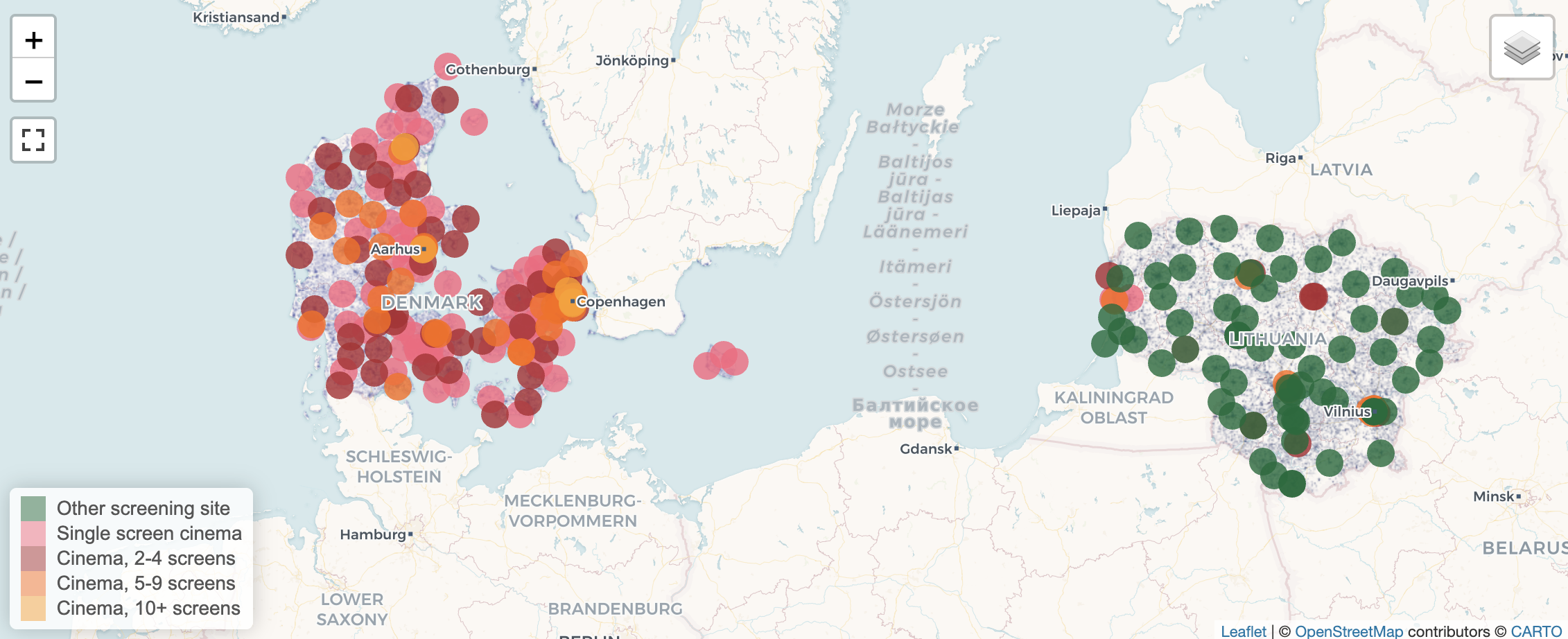
Almost without exception, all the 170 cinemas in Denmark operate as traditional cinemas in the sense that they show films on a daily basis or at least several times a week. This is also the case for the 22 cinemas in Lithuania, but not for its cultural centers (and other screening venues).
There are also significant differences as regards the composition of different types of cinemas. Raats et al (2024), in their study of the cinema infrastructure in Flanders and Brussels, distinguish between multiplex cinemas, independent commercial cinemas, and art cinemas. They furthermore identify cultural centers and so-called cultural exhibitors, e.g., cinematheques and specialty theatres that show, e.g., film classics, experimental films, cult films. The latter focuses on second-run films and is therefore less important for the purposes of this article, but we will return to the role of cultural centers in the Lithuanian case. The taxonomy offered by Raats et al works reasonably well as a basis, but some qualifying additions to their definitions and an additional category of cinemas are important in the context of this particular study. For this analysis we will propose the following taxonomy:
Comparing the cinema landscape in Denmark to that of Lithuania, there are differences in all categories. According to the Baltic Film, Facts & Figures, nine of Lithuania’s cinemas are characterized as multiplex cinemas. They all fit the above definition and include Forum Cinemas, Apollo Cinemas, Multikino (Vue), and Cinamon Mega – all of which have foreign owners. These nine cinemas constitute more than 70% of all cinema screens in Lithuania. In Denmark, multiplexes as defined above would typically be member of the sub-union for Firstrun cinemas in larger cities (Da. Foreningen af premierebiografer, FP). These include the cinemas run by Nordisk Film (23) and Vue (3) which account for just shy of 40% of all screens in Denmark. With its 23 cinemas and more than 150 screens, Nordisk Film is not only a clear market leader, but also a domestically based, vertically integrated company the likes of which does not exist in Lithuania. As regards art cinemas, there are at least a dozen art cinemas in Denmark compared to about a handful of art cinemas in Lithuania with the additional difference that the art cinemas in Denmark are distributed across a substantially higher number of cities.
Without underestimating the important differences as regards the multiplex and art cinema landscapes in Lithuania and Denmark, the most significant difference lies elsewhere, namely as regards community-run cinemas, independent commercial cinemas and culture centers.
Approximately half of the 170 cinemas in Denmark are community-run cinemas most often owned by the local municipality. These cinemas exist in Lithuania as well, but they are very few in number. Although these particular cinemas themselves rely substantially on volunteer work (Karlsen, 2025) and without a doubt fulfill important cultural and social functions they arguably also serve important economic functions in the Danish film ecosystem. In addition, there is also a high number of independent commercial cinemas in Denmark, including a few domestic mini-chains such as the MovieHouse, Biografkompagniet and Big Bio cinemas. Altogether the cinema landscape in Denmark is more diversified than that of Lithuania.
The more important factor, however, concerns the geographical coverage of cinemas in Denmark versus that of Lithuania. Correlating addresses and population statistics shows that no less than 74 of the Danish cinemas are in villages/towns with less than 10.000 inhabitants (see fig. 4.3). In comparison, there are no cinemas in Lithuania in villages/towns with less than 10.000 inhabitants and only four cinemas in cities with less than 30.000 inhabitants, one of which, Naglis Cinema in Palanga, is undergoing multi-year reconstruction work (Infes nd).
On the other hand, some rural areas in Lithuania are served by cultural centers or similar facilities that have screening facilities. These cultural centers typically only show films once a week, fortnight or month but are included by the Lithuanian Film Centre in the Baltic Film, Facts and Figures within the category of “screening places” (e.g., 2025, p. 6). Building on an overview provided by the distributor, ACME Film, we have geolocated all of these screening places as well and parceled them out into their respective city size for comparison (see the second slide in fig. 4.3). We will return to these cultural centers later when looking at the domestic admissions for Southern Chronicles (2024) to test to what extent these compensate for the lack of cinemas in rural areas.
As fig. 4.4 illustrates that there is also a high concentration of cinema screens in the larger urban areas in Lithuania, with more than 80% of the cinema screens being in cities with more than 100.000 inhabitants, whereas the cinema screens are more evenly distributed across differently sized cities in Denmark.
The geographical distribution of cinemas is a particularly important parameter because there are significant differences (at least in Denmark) as regards the performance of local titles in cinemas in differently sized cities.
4.2 Domestic films in rural cinemas - Denmark
An essential component of the high domestic market share in Denmark is the strong performance of domestic titles in rural cinemas. Analyses based on databases provided by Statistics Denmark show that across a ten-year period (2015-2024), the domestic market share is 42.7% in cities with less than 10.000 inhabitants, whereas it is 22.9% in the capital region (author’s calculation, see fig. 4.5). The general pattern is “the smaller the city, the higher the domestic market share”. Second, cinemas in smaller cities are not insignificant in terms of overall admissions to local films (also included in fig. 4.5). On average, for the ten-year period (2015-2024), cinemas in cities with less than 30.000 inhabitants represent 868.000 yearly admissions to domestic films alone, a remarkable share of 28.5% of all admissions to domestic films (fig. 4.5). Consequently, the near lack of cinemas in those kinds of cities in Lithuania raises important questions as to what a differently envisioned cinema infrastructure might accomplish for domestic cultural resonance-oriented films in Lithuania.
Beyond the boost these cinemas give to admissions to local films, it is also worth noting that cinemas in smaller cities are not irrelevant to the overall admissions, including both national and non-national titles. Across the ten-year period of 2015-2024, the share of admissions to all films is actually higher for cinemas in cities with less than 30.000 inhabitants (app. 21.4%) than in the three cities with 100.000-499.999 inhabitants (18.9%) (fig. 6). Economically, ticket prices are typically lower in community-run cinemas compared to multiplexes in the larger cities, and a larger proportion of tickets are arguable sold at a discount through membership of Biografklub Danmark (Karlsen, 2025). Nonetheless, cinemas in small cities are not insignificant from a box office perspective either.
As evidenced in the figures. 4.3-4.6, the existence and state of cinemas in smaller cities is important and can make particularly significant contributions to the cultural resonance-avenue.
If we turn our eye to Denmark to uncover why local films do so well in rural cinemas, we should first acknowledge that the more than 100 cinemas in cities with below 30.000 inhabitants include both independent commercial cinemas and even two multiplexes run by Nordisk in Frederikssund and Nykøbing Falster. Nonetheless, particularly in cities with fewer than 10.000 inhabitants, the large majority of cinemas belong to the Union of Smaller and Medium-Sized Cinemas (FMMB). The sub-union currently constitutes a membership basis of 83 cinemas in Denmark, the large majority of which are placed in rural areas. To get a better sense of the repertoire and overall characteristics of these cinemas, we conducted an interview with the head of the sub-union, Carsten Karlsen.
Karlsen describes the key audience of community-run cinemas as children up until 11-12 years and adults above 30, with a stronger orientation towards female audiences (Karlsen, 2025). Given that many of these cinemas only have one screen (see fig. 4.4), they not only face tough choices regarding what films they program but also regarding how long they run a title. Both in Denmark and Lithuania, the average number of screens per cinema is generally lower the smaller the city, except for the larger capital areas of Vilnius and Copenhagen that have a more diverse combination of cinema types. The lower number of available screens in rural cinemas presents different challenges as regards which films to program. If cinemas in smaller cities show predominantly local films compared to, for instance, US blockbusters, this may of course explain differences regarding domestic market share. It has not been possible to collect data for a full repertoire analysis of screenings across differently sized cities, but interviews (e.g., Ladegaard, 2023) and sample analyses in Denmark suggest that these cinemas generally run big-budget international films just as the multiplexes in larger cities – a point confirmed by Karlsen (2025). Karlsen also confirms the popularity of domestic titles in his sub-union of cinemas but hypothesizes that the largest repertoire differences between small-town cinemas and cinemas in the larger cities are less evident in the split of national/non-national titles than it is regards the total number of films that they run and the run length of national vs non-national titles. As Karlsen puts it, “you water the flowers that grow” – and in his sub-union, these flowers are often national titles (Karlsen 2025).
4.3 Domestic films in rural cinemas – Lithuania
As evidenced in the case of Denmark, the existence and state of cinemas in smaller cities is important and can make particularly significant contributions to the cultural resonance avenue.
The cultural resonance-avenue obviously also relies on funding infrastructure such as the Market Scheme at the Danish Film Institute, broadcaster investment, strong local distributors with marketing clout, and the ability to provide solid Minimum Guarantees. Not to mention a production community with the will and skillset to produce films that connect with wide audiences on the basis of cultural-historical proximity and specificity, including culturally anchored IP. However, with a relatively high domestic market share and a recent repertoire of both critically acclaimed and commercially successful films (some without production support from the Lithuanian Film Center), one might say that the Lithuanian ecosystem has already showcased that the main problems lie elsewhere.
According to film producer Kestutis Drazdauskas, the disconnect in Lithuania relates more to cinema infrastructure than to funding or production patterns:
In Lithuania, we have an issue with the limitations of available screens. If you make a film in Lithuanian, you will be fighting against Hollywood productions, against other countries’ productions on the same premises. […] You just don’t have a wide enough pipe. […]
The cinema infrastructure in Lithuania is run privately. It’s mostly multiplexes. They have their owners outside of Lithuania, and they are programmed to cater to Hollywood masters essentially. I brought up this issue that we are financing - publicly – Lithuanian films, but we don’t have the right tools to actually show them to the audiences because most of the screens are concentrated in the biggest cities, and although we have like 50 municipalities in Lithuania, only around ten, I think, were showing films on a regular basis.
This led Drazdauskas to propose a chain of public cinemas in 2014, suggesting that if properly set up (not unlike the way community-run cinemas typically function in Denmark), cinemas in many mid-sized cities would be able to stay afloat (ibid.). For various reasons, this has not materialized (ibid.). What the comparison to cinema infrastructure in Denmark adds to these policy reflections is the particular impact such an initiative might have with regard to the cultural resonance-avenue.
We saw that there are on average 868.000 yearly admissions to local films in Denmark in cinemas in cities with less than 30.000 inhabitants. The near lack of cinemas in those kinds of cities in Lithuania leads one to ask if Lithuania, if equipped with a cinema infrastructure akin to the Danish one, would generate (adjusting for population size) an additional 400- 450.000 yearly admissions to local films?
Unfortunately, we do not have as granular admissions data for Lithuania as we do for Denmark, and even if we did, discretionary measures would prevent us from presenting the data in a one-to-one comparison. However, with the kind contribution of producer Lukas Trimonis of Nafta Film and Miglė Morkūnaitė & Ernestas Žiaukas of ACME Distribution, we can reflect on these matters with the aid of Southern Chronicles (2024) as a test case. With its 412K admissions, Southern Chronicles was not only the top-performing film in domestic cinemas in 2025 (premiered in January of 2025) but also the best-performing film in modern Lithuania. Worth noting is also that Southern Chronicles had a run in all of the 21 cinemas currently in operation in Lithuania and screened in more cultural center/screening venues than are officially registered by the Lithuanian Film Centre. Relative to population size, the 412K admissions of Southern Chronicles are remarkable and it is the film that comes closest to maxing out the potential of a local title in the current cinema landscape of Lithuania. It is thus a very good candidate for testing the limits of the cinema infrastructure in Lithuania.
Briefly stated, Southern Chronicles is a coming-of-age comedy-drama set in the early 90s, a few years after Lithuania’s independence. Adapted from a best-selling novel by Rimantas Kmita’s, the film tells the story of 17-year-old Rimantas (Dziugas Grinys) navigating life in the post-Soviet Lithuania of the 1990s. Initially captivated by rugby, music, and the streets, his perspective begins to shift after meeting Monika (Digna Kulionyte), a girl from a middle-class background who introduces him to literature, culture, and a different way of viewing the world. In terms of audience demographics, the film is cleverly positioned in a way that it has a youthful coming-of-age vibe but is simultaneously a period piece set in an era that many mature audiences can remember. When asked about the phenomenal success of the film, Lukas Trimonis speculates that the success of the film relies exactly on its wide demographic appeal: I think the only way to have this amount of audience in Lithuania is because this film was relevant to a very wide group of people meaning that it was enjoyed by youth - teenagers, late teenagers – and also was seen by retired people and [audiences] in between[…] I don’t know what the attractive point was for each segment, but from a bit of social media monitoring, it seemed that younger audiences were really driven and taken by the first love story, and this (early post-)Soviet world that they haven’t lived through is a bit exotic. For others, it was a bit more nostalgic. (Trimonis 2026) Trimonis’ hypothesis seems probable to this author. Consequently, a breakdown of the admissions for Southern Chronicles provided by ACME films not only gives us an interesting view into the admissions patterns of that particular film but given its uniquely broad appeal and wide release, a chance to reflect on what its admissions can tell us about the cinema infrastructure in Lithuania.
Looking at the breakdown of admissions, we see for instance that cultural centers pick up 5.8% of the admissions, and an additional 2.5% come from cinemas in cities with less than 30.000 inhabitants. To get a sense of how this compares to the Danish case, we include data showing how the admissions of the average Danish film is distributed across differently sized cities for the entire 2015-2024-period. For discretionary reasons, the admissions data for Southern Chronicles is aggregated slightly differently than the Danish data but we clearly see that 8.3% of the total admissions from cinemas and cultural centers in cities with less than 30.000 inhabitants is far below the 28.5% that the average Danish film took in from small-town cinemas in equivalently sized cities across the 2015-2024-period.
4.4 Conclusion
The analyses presented here lead to a range of conclusions that have important policy implications both for the Lithuanian and the Danish film ecosystems, particularly as relates to the ways in which these are geared towards what we term the cultural resonance-avenue. From the perspective of the Lithuanian film ecosystem, the comparison suggests that cultural center screenings do not, from an admissions perspective, compensate for the lack of rural cinemas, and hence strengthen the case for Drazdauskas’ public chain of cinemas proposal.
The refurbished Naglis cinema project is an example of this type of policy intervention, though obviously just one cinema. Establishing multiple cinemas or alternatively restructuring multiple existing screening venues to community-run cinemas with regular screenings is, of course, a tall task with e.g., financial, technical, organizational, and even political obstacles (Drazdauskas 2024, Karlsen 2025).
We will never know how Southern Chronicles would have performed with a better cinema infrastructure, but we can see that it requires more from both a marketing and audience perspective to counteract the meagre cinema infrastructure of Lithuania. Essentially, it requires substantial “training” of audiences. First of all, it requires more mobility on the part of the audience. Miglė Morkūnaitė of ACME suggests that audiences “who live in small towns close to bigger cities often go to those big cities for shopping, and sometimes visit the cinema there as well” (2026). One might – as indicated by Drazdauskas – ask if shopping mall multiplexes are the best fit for establishing or enhancing the communal experience associated with many cultural resonance films (Šiber 2024, Karlsen 2025), but at least the technical screening standards will be high, and some multiplexes do make more than a rhetorical effort to serve as ‘the house of local films’. Second, audiences in rural communities have to accept a limited choice of films. Third, they also have to act fast, given that they often only have access to a film in a single-screen venue that may only screen films once a month.
We did see that Southern Chronicles, to some extent, appears to supersede many of the obstacles that the cinema infrastructure lays out in front of it, but it may be, as also indicated by Trimonis, that Southern Chronicles is highly unusual, meaning that one cannot expect recurring films with this remarkable type of cross-demographic appeal. Fourth, rural audiences will also have to accept lower technical standards in their local screening venue.
For instance, only a handful of the cultural centers in Lithuania have DCP screening facilities (ACME 2026). If one cannot change the cinema infrastructure, the policy focus would instead be to establish measures aimed at counteracting these obstacles, e.g., through special pools aimed at launching and marketing films and building activities around screenings (e.g., talks, events, cinema bus screenings) or upgrading the screening facilities.
Still, the cinema infrastructure capacity ceiling may disincentivize some of these initiatives. Furthermore, some technical logics (e.g. concerning sound) make it difficult to establish multi-functional screening facilities (Drazdauskas 2025, Karlsen 2025).
For the Danish case, the policy landscape looks very different. Considering alternative cinema infrastructures, e.g., in Lithuania, it is important to acknowledge the importance of rural cinema infrastructure and not take it for granted. If the cultural-resonance avenue is a policy priority, it is important to nourish – e.g., through production and distribution/marketing support - the types of productions that resonate with local audiences in community-run cinemas. However, it is important to look beyond production funding. The Film Act of 1997 explicitly mentions the objective of promoting not only film production but also “film culture” and “cinema culture”. It is indeed important to look beyond funding measures for films to cultural resonance-dynamics more broadly speaking. The quantitative data tells us that it is as much the Danish film ecosystem that needs the provinces as vice versa.
Given the general post-COVID drop in admissions in the streaming era, it may seem counterintuitive to bring more cinemas into the world or to invest significantly in upholding the current cinema infrastructure. Nonetheless, this is in fact what this research points towards.
In short, a three-tier argument seems key. On the one hand, the analyses suggest that cinema infrastructure in rural communities is financially significant to both producers and distributors, even though a significant number of these cinemas themselves are not necessarily for-profit enterprises.
A second key argument for cinemas in rural communities is their civil society functions (Karlsen 2025). The social and cultural functions of cinemas in rural communities have been important at other stages in history (see e.g., Kau & Dinesen, 1983; Sjöholm, 2003; Asbjørnsen & Solum, 2008). However, there are important reasons to revisit these functions. First of all, following the post-COVID decrease in admissions, all cinemas – not only community-run cinemas - are facing increasing pressures to build activities around theatrical releases and to expand their activities beyond merely screening films. This entails running loyalty programmes for seniors, children, and young audiences; eventifying film screenings through e.g. talks, panels, lectures, food/beverage servings, and musical performances. It also involves expanding their programming activities to, e.g., opera, orchestral performances, sports events, et cetera. Many community-run cinemas are deeply involved in these activities already. The community-run cinemas remind Karlsen of the local waterworks, in that they are so far removed from each other that they are not in direct competition and can apply what he refers to as a ‘share and steal’ ethos (Karlsen, 2025).
Second, our digital media culture is undergoing significant audience fragmentation, undercutting the cultural forum function traditionally performed by public service media. The trajectory of legacy media into the digital realm has many implications for political polarization, media and trust, the importance of publicist media in digital public spheres, for instance.
Particularly considering the rich associated activities that community-run cinemas are often undertaking (Karlsen, 2025), there is an obvious potential for cinemas in general and community-run cinemas in particular to (re-)establish spaces for social cohesion and/or democratic dialogue and to take on some of the functions traditionally associated with village and town halls.
When asked about the key challenges facing community-run cinemas, Karlsen emphasizes two key areas: one concerns financial means, the other concerns volunteer culture. The Danish Film Institute’s pool for cinema upgrades is currently only open to art cinemas.
Community-run cinemas must instead pursue other options. Given the financial pressure on most municipality budgets, this typically means private funds. The challenge for community-run cinemas is that the investment per sold ticket for new projectors or sound installation is typically higher in these cinemas compared to urban multiplexes.
Many community-run cinemas also do not have a concessions set-up to shoulder these expenses. For Karlsen, any kind of financial support mechanism has the benefit of freeing up human resources to organize the activities involved in running a community-run cinema, including those with clear civil society functions (Karlsen 2025).
The second challenge highlighted by Karlsen concerns volunteer culture, e.g., the challenge of recruiting, organizing, and motivating volunteers. Community-building volunteer culture itself is changing (Karlsen, 2025). What limits the individual cinema is effectively the community of volunteers that it has managed to organize. Cinema owners can, in some cases, be “city kings” (Karlsen, 2025) and are not necessarily equipped with these organizational skills and insights into contemporary volunteer culture. However, there is a growing body of research on volunteering, and given the importance of volunteer culture for community-run cinemas, upskilling courses are an obvious option which, for instance, the Danish Film Institute could help fund, for instance, through Danske Biografer, the national organization body of cinemas.
4.5 Methodology
Key resources consulted in this article include the “Biografer & Film” database at Statistics Denmark. We thank Senior Advisor Cecilie Bryld Fjællegaard for ongoing correspondence about the database and their admissions qualification process. Cinema addresses have been collected from the Danish Cinema Union (Danske Biografer), supplemented by manual searches and contributions by Carsten Karlsen. City population (January 2025) has been collected from Statistics Denmark (”BY3: Befolkningen 1. januar efter byområder, landdistrikter og folketal, areal og befolkningstæthed”). Also, thanks to Dorte Wiedemann from FAFID, the Danish distributor organization, for clarifying their admissions collection process, and to Sonja Overgaard Olsen (Danish Cinema Union) for helpful documents.
The Danish Cinema Union is divided into sub-unions. These do not fully overlap with the taxonomy suggested in this article, but serve as a useful compass. The three cinemas in Greenland and three in the Faroese Islands are represented in these sub-unions but are not included in the 170 for methodological reasons. Lithuanian cinemas are not organized in a similar fashion. A few cinemas in Denmark refer to themselves as “culture houses” or “cultural centers”, but they are not cultural centers in the same way as those in Lithuania. Their “culture house” denomination alludes to them being multifunctional sites that include, for instance, theatre/musical performances, but save for a few exceptions, they still screen films on a regular basis.
For the analysis of cinema infrastructure in Lithuania, Austė Jucytė of the Lithuanian Film Center (LFC) oversees cinema and cultural center registration, e.g., the Baltic Film, Facts and Figures, and the European Audiovisual Observatory. She has been very helpful as a data provider and sparring partner. Some sources set specific quantitative thresholds for when a cinema is counted as a multiplex (e.g., EAO’s 8+ screens). We weigh qualitative dimensions higher. Lists of cultural centers & and similar venues that screen films in Lithuania have been kindly provided by both the distributor ACME and LFC. The ACME list matches the LFC data for 2024 and is therefore used in this article. LFC’s cultural center registration may vary slightly from year to year. Addresses have been manually searched and geolocated on the basis of these lists. Manual searches for 2025-film screenings in cultural centers were conducted for app. 40% of the venues for validity check. Venues were placed in their respective city size on the basis of population data from Statistics Lithuania, cross-referenced with city statistics provided by citypopulation.de/en/lithuania/cities/.
Examples of what Raats et al (2024) refer to as cultural exhibitors, such as Husets Biograf in Copenhagen, are not members of the Danish Cinema Union and are not included in the 170 cinemas. The Lithuanian Film Center, in their tabulation of “screening places” (beyond cinemas), includes venues that could belong in either the cultural center or the cultural exhibitor category (e.g., screening places in art galleries). Raats et al (2024) also list film clubs. These are not included in this study.
A number of expert interviews inform the analysis:
Carsten Karlsen (Head of The Union for Smaller and Medium-Sized Cinemas). Online interview by Jakob Isak Nielsen, December 12, 2025.
Lukas Trimonis (producer). Online interview by Jakob Isak Nielsen, January 9, 2026.
Kestutis Drazdauskas (producer). Interviewed by Marius Øfsti & Jakob Isak Nielsen, stakeholder workshop in Zagreb, November 4, 2024.
Miglė Morkūnaitė (ACME). Email correspondence January 2026.
Ivor Šiber (producer, distributor). Interviewed by Jakob Isak Nielsen & Marius Øfsti, Zagreb, November 6, 2024.
Claus Ladegaard (CEO of the Danish Film Institute at the time of the interview).
Interviewed by Jakob Isak Nielsen, Copenhagen, 21 September 2023.

Domestic Distributors and the Competitiveness of Domestic Films in Denmark and Portugal
5.1 Introduction
Distribution is a key site of power in the film industry. Their dominant position as distributors is considered key in the rise of the traditional Hollyood studios. US based studios and streaming services continue to hold a dominant position in distribution across the globe and across various forms of exhibition. This is a major competitive advantage that allows them favorable terms with both producers and exhibitors. Their global reach and access to funding for marketing and acquisitions make them attractive for producers that are willing to accept less favorable terms in exchange for a higher upfronts or higher total earnings. This in turn gives US based studios attractive slates that can be leveraged into favorable terms with exhibitors, including the ability to demand a minimum number of screens, the most attractive time slots and higher rentals. Yet there is limited research on the role of distributors outside of the US studios and streamers, and much of the existing research focuses on the role of distributors as gatekeepers for reaching international markets. This article looks at two of the Crescine markets, Denmark and Portugal, in an attempt to identify how the distribution landscape of any given market contributes to competitiveness for domestic titles.
For film producers a distributor offers three potential value adds:
• Funding at an early stage, by offering a minimum guarantee (MG) for distribution rights.
• A network of established contacts with exhibitors, including cinemas, broadcasters, VoD services and so forth.
• Experience in negotiating contracts with these exhibitors, and experience with marketing domestic titles.
In many countries public funding requires a distribution deal or a letter of interest from a distributor. In these cases, distributors can become key gatekeepers whether they actually provide significant value adds to the project or not. It is further important to consider experience with domestic titles specifically, as this varies significantly from marketing and releasing films that come with pre-produced marketing material and in some cases additional funding from the first run-distributor.
5.2 Distributor characteristics
Using data from Lumiere Pro on all theatrical releases in the Crescine markets in the period 2014 to 2023 we have examined a number of characteristics of small market film distributors, including their share of total admissions, number of titles released, genres and country of origin of films released. In addition to these quantitative characteristics, we have looked at selected distributors to assess whether they are vertically integrated with production or exhibition, as well as country of origin for the final owner. Our analysis reveals that small market distributors can be categorized as either “high-resource” or “low-resource”, depending on their average admissions. In addition to the divide between high- and lowresource distributors we have also looked at the share of titles released by any distributor that are domestic. The varying share of domestic titles is a key aspect of small market distributors, as it relates to their roles as first run-distributors or sub-distributors. First rundistributors typically develop and fund the initial marketing campaigns, usually in close cooperation with the producers, and bring the movies to their first release market. Subdistributors release films where another first run-distributor has developed the marketing campaign for the release in the main market.
From the producer’s perspective, the distributor should provide more value in the form of increased revenue, than what is lost to the distributor’s fee. The ideal distributor is therefore high-resource, to provide a significant MG and leverage in negotiations with cinemas and other exhibitors and has significant experience with releasing domestic titles. Two of the distributors in the Crescine markets that potentially fit this description are Denmark’s Nordisk Film and Portugal’s NOS Lusomundo Audiovisuais.
5.3 A tale of two giants: Nordisk Film and NOS Lusomundo Audiovisuais
In many aspects, Nordisk Film and NOS Audiovisuais are highly comparable. As seen in the figure below, both companies are the market leader in their respective markets when the overall share of admissions is considered, both also release more domestic titles than any other distributor in their markets. This makes them potentially valuable for domestic producers as they have experience with domestic films, and leverage with exhibitors. Both companies are also vertically integrated with the leading theatre chain in the country, further strengthening their influence over exhibition.
NOS Lusomundo is as a subsidiary of the NOS Group, a major telecommunications and media conglomerate in Portugal, consistently ranked in second place in terms of market share in the telecom sector. Historically, NOS Lusomundo emerged from the restructuring of Lusomundo Audiovisuais, a dominant media group in Portugal during the late twentieth and early twenty-first centuries. Following a series of mergers and acquisitions in the media and telecommunications sectors, the Lusomundo brand became integrated into NOS, resulting in the current corporate configuration in 2014. In the field of film distribution, NOS Lusomundo’s catalogue has traditionally been dominated by mainstream international cinema—particularly Hollywood studio productions—while also encompassing European films, particularly French and British, as well as selected Portuguese titles. Through its distribution strategies, the company has played a decisive role in shaping patterns of film circulation, audience access, and box office performance in Portugal.
A defining feature of NOS Lusomundo is its vertical integration within the film value chain. The company is closely connected to the largest cinema exhibition network in the country (NOS Cinemas), enabling synergies between distribution and exhibition. Beyond traditional theatrical distribution, NOS Lusomundo operates within a broader media convergence environment, linked to television channels, on-demand services, and digital platforms owned or operated by the NOS Group. NOS Lusomundo’s dominant position in distribution and exhibition is further enhanced by the fact that there are no vertically integrated competitors.
After Cineplace ceased operations in January 2026, UCI is NOS Cinemas’ nearest rival in exhibition, with 42 screens and 10.7% share of the box office, compared to NOS’ 218 screens and 68.2% market share in 2024 (ICA 2024). In distribution, NOS Lusomundo lost significant market shares after losing their output deals with Universal and Warner Bros. to Cinemundo in 2020 and 2021 respectively. As a result, NOS Lusomond’s market share fell from 70% in 2019 to 37% in 2023, when Cinemundo became the market leader with a share of 42%. Neither of the companies have been involved in production, and NOS releases titles from a wide range of Portuguese production companies.
Nordisk Film’s history is in many ways comparable to that of many major Hollywood studios. First established as a studio in 1906 by cinema owner Ole Olsen, the company has been involved in production, distribution and exhibition since. In 1992 Nordisk Film became a part of the Egmont group, a major player in across a range of media industries in the Nordics, including film, television, advertising, gaming, and publishing. Nordisk Film is currently active in film production, distribution and exhibition in Denmark, and has distribution and production subsidiaries in Norway, Sweden and Finland. Nordisk is also a major exhibitor in Norway and runs two cinemas in Sweden. Nordisk Film is the market leading exhibitor in Denmark, with around 40% of the market, and the only company to be involved in all parts of the value chain.
While Nordisk Film has been the overall market leader among Danish distributors in the 2014 to 2023 period, the position is significantly less dominant than that of NOS in Portugal. Some of the competitors, notably SF Studios and Scanbox, are also part of transnational corporations and are vertically integrated with production companies. Nordisk lost their last major Hollywood deal in 2019 when 20th Century Fox was acquired by Disney. Since then, Nordisk has only released a small number of US films, most of which are part of an output deal with Lionsgate that covers all the Scandinavian markets. Films produced by Nordisk Film or its subsidiaries make up almost two thirds of their domestic releases, while the rest of the domestic titles come from other Danish production companies. Despite being integrated with Nordic production companies, Nordisk only released nine Norwegian, six Swedish, and no Finnish films in the ten-year period.
5.4 Relation to domestic film industry
Further differences between the roles Nordisk Film and NOS play within the industries emerge when their share of all domestic admissions in the market are considered against the share of admissions each of the distributors gain from their domestic titles. NOS Lusomundo is still dominant, garnering on average 64% of all domestic admissions, with no other distributor reaching higher than 10%. Nordisk Film also becomes dominant reaching an average market share of 70%, compared to SF Studios’ 10%, when only domestic titles are considered. However, where domestic titles make up 74% of all of Nordisk Films admissions, NOS gains only 4% of their admissions from Portuguese titles.
Much of this difference is due to the different market shares of Portuguese and Danish films in their home markets. Yet, while NOS Lusomundo’s share of admissions from domestic films matches the 4% domestic market share for all Portuguese films, Nordisk Film’s share of domestic admissions is twice the 30% domestic market share for Danish films. This shows that while the Danish industry is perhaps more dependent on Nordisk Film than the Portuguese is dependent on NOS, Nordisk Film is also highly dependent on the Danish industry. By contrast, the Portuguese film industry is still highly dependent on NOS, while NOS is unlikely to see much revenue from domestic films.
The two markets also diverge when we return to the producers point-of-view and consider their alternatives. A Danish producer with ambitions for high domestic admissions could approach both SF Studios and Scanbox, if unable to strike a satisfying deal with Nordisk Film.
A Portuguese producer has significantly less choice. Cinemundo has released a small number of Portuguese films and could yet prove to be a potential challenger for NOS in this space but did not release any domestic films in 2023. The large number of Portuguese titles self-distributed by the production company or without a listed distributor in the Lumiere database suggests that there is a mismatch between the number of distributors willing to release domestic films, and the number of films produced.
5.5 Conclusion: distributors as infrastructure
This brief comparison of the giants of the Danish and Portuguese distribution landscape can’t explain the differences in the domestic market shares nor can any of them be blamed or praised for domestic success or lack of such. It does, however, point to aspects of both companies and distribution landscapes that can help or hinder a strong domestic market share.
The mutual dependence between Nordisk and the Danish industry coupled with the presence of competitors for domestic films, incentivizes Nordisk to ensure that their domestic films perform well. This possibly includes investing in higher MGs to increase the films budget, investing in marketing, and ensuring a prominent theatrical run. NOS Lusomundo, on the other hand, has few incentives to invest beyond a minimum and has very few competitors. Yet, as a dominant cinema chain and major telecom player that only operates within Portugal, NOS could be envisioned as an important ally to Portuguese films with domestic ambitions. Across the Crescine markets we see that ecosystems with a high domestic market share tend to also have higher overall admissions per capita. It would therefore be likely that increased admissions for Portuguese films in Portugal would also increase the overall admissions, which in turn would benefit NOS as a cinema operator.
The lack of investments in domestic film production from NOS has complex reasons, of which the standing of Portuguese films in the general public and the funding schemes and orientation of Portuguese film production are key. Yet, this comparison also highlights the differences in the corporate structures and histories of Nordisk Film and NOS Lusomundo.
Nordisk Film is vertically integrated with production as well as exhibition and is situated within a cultural industries focused conglomerate. NOS Lusomundo is not integrated in production and is situated within a primarily telecom-based conglomerate.
We argue that any policy that seeks to increase the competitiveness of domestic films in their home market, must consider the role of distributors (and cinemas) as infrastructure. This includes policy that supports strong domestic distributors that are incentivized to invest in domestic films, also in cases where these private and for-profit companies, while also ensuring that producers also have several options. While further research mapping distributors in small European markets and their role in support domestic films is needed, the lessons from Denmark and Portugal indicate that a healthy distribution landscape for domestic films is comprised of several companies that are competitive in the marketplace and committed to the commercial as well as artistic success of domestic films.
VoD distribution of small market film between domestic VoD availability and international spread: Denmark and Estonia
By Cathrin Bengesser and Sten Kauber
6.1 Introduction
Video-on-demand (VoD) distribution is an important factor for the availability and circulation of small market films. Crescine’s interactive database on VoD distribution of films produced in Europe shows that small markets achieve a similar level of VoD circulation to large markets.
Still, a few small market films make it to the globally operating Subscription Video-on-Demand (SVoD) services, and the differences between the small markets are vast. Crescine’s research has also shown that despite the increasing opportunities for VoD distribution, theatrical release is still key for determining the success potential of film in later windows (Hammoud et al., 2025). In this contribution, we therefore take a closer look at the domestic and international VoD circulation patterns of films from Denmark and Estonia to investigate 1) how they relate to the small market orientations based on domestic theatrical admissions, export, and festival participation, and 2) how these orientations intersect with local VoD infrastructure and market development.
Denmark and Estonia’s film industry are both characterized by a strong orientation towards cultural resonance that manifests in strong domestic market shares and a primary attention on viewers at home. The two markets differ in audience size because of their differences in population (Estonia at 1.3 million and Denmark at 6 million) and penetration of VoD usage. This raises the question of how transnational VoD services’ localization practices through domestic film differ for smaller or more peripheral markets. Neither Denmark nor Estonia has a strategic focus on export. Denmark achieves international theatrical release for 65% of its output in a median of 3 markets, while 44% of Estonian theatrical feature films are released internationally in a median of two markets. This makes the two countries an interesting test case for investigating whether international VoD circulation can help small markets overcome challenges in theatrical export.
Together, the two cases help understand how the value of small market film differs from the distribution context (national/international) and across different types of platforms: global SVoDs (Amazon, Disney, Netflix), local/regional VoDs including public service broadcasters’ streaming offers (e.g. DR TV, Viaplay, Go3), as well as specialized or niche services on national or transnational level (e.g. Filmin, MUBI, Docsville). The method section at the end of this article explains how the data has been analyzed and processed. Understanding these differences is key to understanding small market films’ position in the competition for space and attention on VoD services and for making policies suited to increasing the availability and circulation of small market films on VoD.
6.2 Domestic availability of small market film
Denmark
Denmark is a highly developed VoD market. More than three-quarters of the population use VoD services (2024), and subscriptions to multiple services per household are common. At the same time, Denmark’s VoD market is characterized by strong local players, since the big global SVoD services accounted only for 39.72% of subscriptions in Denmark at the end of 2023 (EAO Yearbook, 2024) – which is low compared to the EU average (for details on the method for market development assessment, see Bengesser, 2024).
In terms of weekly reach among the Danish population over 3 years, the public service broadcasters (PSB) Danmarks Radio (39%) surpasses Netflix (32%), closely followed by the commercial PSB SVoD TV 2 Denmark (30%). The regional SVoD/TVoD Viaplay (19%), Disney+ (17%), and HBO (11%) still surpass Amazon Prime Video (7%) (Medieudviklingen, 2025). In the comparison below, we look at these dominant VoD services and are also adding the public library service Filmstriben, which has circulated the highest number of Danish feature films in the sample period (October 2022-July 2025).
To assess their differences, we compare which strata of Danish theatrical film the services gravitate towards in their acquisition of licenses, measured in the share of the most popular domestic films offered, the share of films with 3+ theatrical export markets, and the share of Danish films that have received festival selections/award nominations (Figure 6.1). The two publicly funded services (DR & Filmstriben) represent a higher share of the cinematic arts-oriented Danish films but offer fewer popular domestic films. In contrast, the commercial public service broadcaster TV 2 is more oriented towards popular film, including popular comedies like the Father of Four franchise and the films based on the popular TV 2 comedy series Klovn (2005-2025). Crescine’s audience research has pointed to the importance of comedy films for achieving domestic market shares and the audience’s sense of cultural resonance (Gracio et al., 2025), but these productions do not export widely.
On the globally operating services, domestically popular cinematic releases are overrepresented compared to the share of Danish cinematic output they make available.
Their offer of a domestically top-performing film is volatile. On Netflix, for example, only 6 of the 39 most popular Danish films were available to Danish viewers in April 2025, while they had a choice of 20 just three months later. All but one of the additional 15 films come from the same distributor, which reflects Crescine’s findings that global SVoDs are increasingly relying on output deals with selected distributors rather than acquisition of individual titles (Øfsti & Nielsen, 2025). These patterns indicate a high competition among the commercial SVoDs – global and local – for domestically popular Danish film.
Estonia
Estonian VoD consumers sit in a comparatively “hybrid” and still maturing streaming environment. Eurostat’s data on internet usage for 2024 shows that 45.4% of Estonia’s population used broadcaster video-on-demand (BVoD) in the past three months in 2024, close to the EU level of broadcaster catch-up consumption, while use of commercial VoD services is lower than the EU average (34.6% vs 49%). This implies that on-demand viewing in Estonia tilts more toward broadcaster ecosystems and mixed access routes than toward full SVoD substitution.
In parallel, EAO data on VoD subscriptions (EAO Yearbook, 2024) indicates 62% of households have at least one SVoD subscription (EU: 66%), yet Estonia is less structurally dependent on the “big three” global platforms (Netflix/Amazon/Disney) than most markets (30% of subscriptions vs EU 61%). This is consistent with a context where local/regional services, telco bundles, and broadcasters retain meaningful weight in household portfolios. This profile also aligns with broader Estonian audience patterns, where cinema-going remains comparatively salient in a European comparison and paid streaming is not the dominant “second choice” after TV (Kauber, 2024). This indicates that Estonian viewers combine strong legacy media-cultural habits with selective, price-sensitive, and often title-driven VoD adoption rather than blanket multi-SVoD saturation.
In Estonia, the tendency for audiences to find local titles via domestic distribution infrastructures is reinforced not only by taste and discoverability logics, but also by policy-shaped windowing: the Cultural Ministry regulation on state film support requires (i) a public premiere within one year after the funder approves the production support final report, and (ii) within two years after the public premiere, a screening on at least one broadcasting service operated under an Estonian media service license. It is explicitly framed as an availability measure for viewers who cannot or would not see the film in cinemas. In practice, this incentivises release strategies that ladder from cinema into TVoD and/or telco-operated (S)VoD offers, followed by a domestic TV premiere and subsequent catch-up/free availability on licensed broadcaster VoD environments. Such a distribution pathway is structurally easier to execute with domestic broadcasters and telco-TV ecosystems than with global SVoDs that do not have such a media service licence. This fits Crescine’s broader finding that cultural-resonance films in small markets rely heavily on domestic infrastructures for both exhibition and audience awareness. It is also coupled with the fact that the largest global services have weaker incentives to commission originals for Estonia or acquire films specifically for the Estonian market, because the upside in subscriber growth is structurally limited by a small population and a small language area, which raises the relative cost of localization and reduces the scale benefits that typically justify market-specific investment. In this context, Estonian titles are more likely to be valued by global platforms only when they can “travel” beyond Estonia (e.g., via genre legibility or prior export performance), while the routine circulation of culturally resonant domestic films remains anchored in national broadcasters and telco-led distribution.
Because the catalogue data from Lumiere VoD and Justwatch did not cover the important Estonian local platforms Jupiter (public service), Elisa and Telia, our analysis of domestic availability in Estonia focuses on the global SVoD services and the available data for Go3. Consistently, our catalogue mapping (Oct 2022–Jul 2025) shows markedly higher coverage of theatrically released Estonian features on local services than on global platforms: Go3 carried 29 of 36 Estonian feature films with a cinematic release during the period, whereas Netflix carried only one title, the action comedy Sangarid (EE/FI/LV, 2018) at any point, and Amazon carried zero Estonian cinematic features. This mirrors the audience-side pattern in our qualitative findings that indicates that Estonian viewers are more likely to seek domestic productions from low-friction and familiar domestic environments (telco services, TV-linked ecosystems, or free public service platforms) rather than actively searching global catalogues for national films (Damasio et al., 2025).
6.3 International VoD distribution of small market film
For the analysis of international distribution, we use a different dataset, namely the VoD availability of Danish and Estonian Films as indicated by Justwatch.com on 28 November 2025, since it covers more countries than the Lumiere VoD data (see methods section below). To analyse which factors in the orientation of small film markets drive their VoD distribution, we have taken the median number of international VoD markets reached on FVoD or SVoD and providers for a) films that are the most popular at home, b) those that have theatrical export track-record, c) those that have festival selection/award nominations and d) those that feature neither of the above (Fig, 6.2).
Films with a theatrical export track record clearly circulate better on VoD internationally than those relying purely on festival acclaim or domestic popularity. In addition, the EAO’s analysis of SVoD viewing data indicates that films with theatrical release and ensuing marketing benefit from awareness in the theatrical window, aiding consumption (Tran, 2025: 29).
Festival selection and award nomination also help the international VoD circulation, just like it helps films’ international theatrical release (Øfsti, 2025). In the Danish case, those few films that can combine all three factors have a clear advantage over the other films. Similarly, the relationship between theatrical export performance and VoD circulation is strongest for Estonian film. Among the Top 10 Estonian films by number of theatrical release markets (Savvusanna sõsarad [Smoke Sauna Sisterhood], Firebird, Risttuules, Captain Morten and the Spider Queen, Eia jõulud Tondikakul, The Little Comrade, 1944, November, Erik Stoneheart, Tagurpidi torn), eight circulated in more than ten VoD territories and three exceeded twenty territories (Smoke Sauna Sisterhood, Firebird, The Little Comrade).
Notably, the set includes the multiple award-winning Smoke Sauna Sisterhood (EE,/FR/IS, 2023), and seven of the ten titles are international co-productions, which suggests that wider theatrical and VoD reach often aligns with films that are “built for” cross-border circulation through their financing and rights structures, as well as co-producer networks, Two titles— The Little Comrade (EE, 2018) and Firebird (EE/GB, 2021) (see Fig. 6.3) — also feature in our Top 10 list by VoD territories, suggesting that a stronger theatrical export footprint is associated with wider international VoD availability in our dataset. This export-linked pattern is also reflected in platform presence: six of these theatrically exported titles were available on
Amazon Prime Video in some territories (Firebird, Captain Morten and the Spider Queen, Eia jõulud Tondikakul, 1944, November, Erik Stoneheart), while Netflix and Disney+ did not carry these titles in our mapping.
Looking at domestic success, the Top 10 Estonian box-office titles (Tõde ja õigus, Klassikokkutulek, Talve, Klassikokkutulek 2: Pulmad ja matused, Apteeker Melchior, Eia jõulud Tondikakul, Klassikokkutulek 3: Ristiisad, Kalev, The Little Comrade, 1944) were all available in more than one VoD territory, and five circulated in more than ten territories. However, only one title exceeded twenty territories—The Little Comrade, which reached 54 territories—and it is also the only film from the domestic Top 10 that appears in our Top 10 list by number of VoD territories. While it reaches broadly on TVoD, The Little Comrade (see Fig 6.3) is only available on SVoD (flatrate) or FVoD (free) in three territories (Sweden, Norway & South Korea). This indicates that strong domestic box-office performance does not, on its own, predict broad international VoD circulation. In terms of the major global services, three of these domestic hits were available internationally on Amazon Prime Video in at least some territories (Tõde ja õigus, Eia jõulud Tondikakul, 1944), while none were available on Netflix and none on Disney+.
Films without domestic popularity, theatrical export record, and festival recognition circulate only to a limited degree. Still, there are examples that circulate across many markets, making use of multi-territory licenses with “third-tier services”, which often focus on specific genres and/or tend to buy back catalogue material (Lynch & Scarlatta, 2022) and are often cheap to subscribe to. The English-speaking documentary False Confessions (DK/US, 2018), for example, circulates in 101 countries, 77 of which are reached via the service Docsville that specializes in documentary film and costs 2.99 US dollars a month (Fig. 6.4).
For films with high VoD circulation, it is most usual to accumulate territories through different providers, often also on a non-exclusive basis. Retfærdighedens Ryttere (DK, 2020) – a popular Danish domestic title that also has theatrical export to 33 markets – is a good example of this pattern (Fig. 6 .4). The film reached 47 VoD markets on SVoD or FVoD, of which 21 were reached via Amazon Prime, partially overlapping with the five territories reached through HBO Max and three through Netflix. 32 different services were involved in the international SVoD/FVoD distribution of this title, ranging from the global SVoDs to regional services (e.g., Go3, Viaplay) to local providers (NPO, Polsat), specialized third-tier platforms appealing to a more cinephile audience (Filmin, Cinemember). Circulation on such different types of platforms has the potential to rebrand a film to the audience in the specific international market, e.g., niche art-house oriented services like Filmin vs. broader mainstream services like Amazon.
This networked distribution contrasts with films that circulate on global licenses (e.g., Lykke Per on Netflix) (Fig. 6.4) or are “original” productions for transnational VoD players circulating on just one service across all its territories.
In the Danish case, there are six Netflix-exclusive Danish feature films produced between 2014 and 2023, which are simultaneously available exclusively across all of Netflix’s territories. The offer comprises two true crime documentaries about internationally known crime cases (Into the Deep, Amanda Knox), three romance comedies/dramas (Ehrengard, A Beautiful Life, Toscana), and one crime thriller (Loving Adults), the latter no longer being exclusive to Netflix as of November 2025.
Emergent research suggests that they sit at the intersection of local cultural resonance and transnational recognizability. Speaking about Scandinavian originals, industry sources claim that global SVoDs are mainly looking for original projects with potential to perform well with local audiences, while numbers on hours viewed indicate that the Danish Netflix originals must have a broad international reach (Øfsti & Nielsen, 2025). As highlighted by Chris Meir (2024), the international audience success of Netflix’s original fiction films from Scandinavia is carried mainly by popular genre traits rather than the festival acclaim that is usually behind successful theatrical exports from the region. The promotional potential behind the prominent placement of originals and exclusives on interfaces (Iordache, 2025) helps the performance of these films, too. Nonetheless, European SVoD original films’ share in viewing has declined in recent years, and they underperform compared to SVoD original series (Tran, 2025: 11). It is also important to stress that Denmark is one of the few small European markets featuring Netflix original film productions; Estonia has none.
6.4 Outlook and policy implications
Domestic theatrical performance creates value and competition for the VoD window in cultural resonance markets, particularly if global SVoDs localize their offer to the tastes of domestic audiences as they do in Denmark. The Estonian case, however, serves as a reminder that very small markets with medium or low VoD uptake may not be seen as lucrative enough for global players to warrant localization. Local platforms, therefore, play a crucial role in ensuring accessibility of small market film to domestic audiences. Policy interventions like the Estonian requirement that domestic films need to have a TV window support this practice. The Danish case also shows that public platforms (DR and Filmstriben) show a more cinematic-arts-oriented profile of Danish film than the more popular-oriented commercial services.
These findings indicate a need for a balanced VoD policy that takes into account a) the public value of ensuring domestic accessibility to film often funded by public resources, b) the commercial value of popular film for which a competition between local and global platforms ensues in ‘attractive’ VoD markets like Denmark, and c) the cultural value of more cinematic arts oriented film that does not necessarily make it to commercial services. The Danish market shows a healthy balance, because close to all Danish films are available to domestic audiences, because services (global/local and commercial/public) differ in their offer of local film and because local services with their specific orientation towards local popularity and/or cinematic art have a strong market share. In the Estonian case, the lack of localization among SVoDs is balanced by obligations for local services to carry Estonian film, which fosters access because Estonian viewers are accustomed to finding domestic film on local platforms. In markets where local platforms struggle to compete for audience attention with global services, such a balance may be harder to create through policy intervention. The lack of adequate data on local VoD catalogues in Estonia (as well as other Crescine markets) indicates a knowledge gap when it comes to monitoring domestic availability and balance in the profiles of services.
Regarding international circulation on VoD, the cinematic export track record is clearly connected to VoD export potential and thereby small market films’ international competitiveness. Because of the connection between theatrical performance and VoD distribution, policy interventions that support the theatrical export of small market film are also suitable for supporting VoD circulation. For films that have proven themselves valuable to international markets in the theatrical window, broader distribution can be accrued across different platforms.
VoD distribution thereby reinforces orientation patterns prevalent in the market rather than challenging or reversing them. While individual films without a proven track record can circulate widely on third-tier platforms, the competitiveness of these niche-oriented services that are not necessarily known to audiences limits the potential of these alternative pathways to international distribution. Addressing this issue, Creative Europe already supports European VoD networks and operators that screen a significant proportion of non-national European works (e.g. Arte, LaCinetek, Doc Alliance) with the aim of increasing their competitiveness.
Original/exclusive productions circulate most widely on VoD, giving global visibility to the titles, but not all the markets benefit from these kinds of investments. The Danish Netflix originals point to a potential avenue for international circulation outside of theatrical track record and festival credentials. At the same time, the comparative underperformance of original films compared to SVoD original series, the unequal distribution of original investments, as well as risks for the local production economy (Øfsti & Nielsen, 2025) should caution against direct streamer investment into originals as the main pathway to increased international distribution of small market film. The limited international presence of Estonian film on the global SVoDs shows inequalities across markets also for licensed material. Investment obligations for international licenses could be an additional lever to use transnational SVoD reach and attention to build international VoD audiences for small market films.
6.5 Methodology
Our analysis is based on snapshots of the VoD catalogue availability of the 568 feature films from Denmark and Estonia produced between 2014 and 2023. Using ten snapshots from the Lumiere VoD database, the domestic availability of feature films from Denmark and Estonia produced between 2014 and 2023 has been tracked across 1 October 2022, 1 January 2023, 1 April 2023, 1 October 2023, 1 January 2024, 1 April 2024, 1 July 2024, 1 January 2025, 1 April 2025, and 1 July 2025. The data covers 55 catalogues available in Denmark and 33 catalogues available in Estonia. The Estonian data is missing catalogue data for three domestic services that are crucial to the distribution of Estonian film: Jupiter, Elisa, and Telia.
Because of its greater coverage of international markets, the analysis of international distribution uses a snapshot (28 November 2025) directly from Justwatch.com – the data supplier to Lumiere VoD. The JustWatch data has been accessed via the TMDB API. The data covers the availability of the 1.602 Crescine market feature films produced between 2014 and 2023 in the catalogues of 430 VoD providers in 139 countries within and outside Europe.
The analysis focuses on distribution on SVoD and Free VoD services rather than TVoD, because the former two are more habitually used by audiences. Because the Lumiere VoD data on Viaplay does not distinguish between the service’s SVoD and TVoD offer, figures for Viaplay include TVoD availability. For the total availability of films in Denmark, Viaplay has been excluded so as not to distort the picture of SVoD and FVoD availability. The Justwatch data allowed for isolating Viaplay’s TVoD from its SVoD offer.
To assess which orientations of small market film are represented on the services, we make use of admissions data from Lumiere Pro. The parameters for orientation are: a) popularity measured in the share of features with the highest domestic cinematic release. For Denmark, the threshold has been set at 250.000+ admissions. For Estonia, it is set at 50.000; b) share of films with 3+ theatrical export markets as recorded in Lumiere Pro, and c) share of films (produced between 2014 and 2022) that have received at least one Festival selection/award nomination (for selection of festivals and awards see Øfsti, 2024).
Collective Agility: Hybrid Competencies and Cultures of Collaboration in Small European Film Markets
7.1 Introduction: from “team agility” to “ecosystem agility.”
Debates on agility in the creative sectors are often reduced to teamwork practices (iterative processes, rapid feedback, “learning by doing”) or to the implementation of specific methods in projects. In small film markets, this perspective is insufficient. Film production and circulation are strongly shaped by public policies, a fragmented structure of microenterprises and SMEs, relational capital, and the infrastructure of intermediaries (funds, film commissions, festivals, markets, networking platforms, educational initiatives, and VoD). As a result, agility becomes a collective property: it is the capacity of the entire system to survive and develop despite structural constraints (market scale, distribution concentration, linguistic peripherality, dependence on public funding).
The Crescine project provides an empirical basis for analyzing these mechanisms through market portraits, indicator comparisons, and case-based evidence on audience building and film literacy in small markets. Specifically, we draw on market diagnostics in the Crescine report Small European Film Markets: Portraits and Comparisons (market portraits and comparative indicators across small film markets, including the synthesis report State of European Film) and Crescine’s audience-focused research (good-practice mapping and recommendations on audience development and film literacy, as consolidated in Crescine’s Policy Recommendations for Building Future Audiences including the Good Practice case studies from the seven countries. On this basis, we focus on three ecosystems for which the material available in the submitted resources is complete and comparable: Estonia, Portugal, and Flanders.
We assume that collective agility in small film markets includes at least three dimensions:
economic–organizational adaptation (recombination of resources and project portfolios),
institutional adaptation (policy scaffolding: funding instruments, regulation, intermediation),
cultural–social adaptation (collaboration cultures, community building, film literacy, and long-term audience development mechanisms).
Only at the intersection of these dimensions can we explain why some small markets are more competitive: resilient, learning faster, and more effectively “switching” between segments (national cinema, co-productions, service work, television, series, festival circuits, and platforms).
In this chapter, we use “orientations” as a practical heuristic for describing how small-market ecosystems prioritize and combine strategic logics that shape competitiveness—i.e., their capacity to secure resources (financing, talent, infrastructures), access circulation channels, and build audiences under structural constraints (Porter, 1985).
In practice, competitiveness rarely stems from a single orientation; rather, it emerges from portfolio-like combinations that require coordination across organizations and policy instruments. For example, combining a cultural-resonance orientation (anchored in language, identity, and domestic audience development) with a production-service orientation (attracting inward investment and maintaining continuous production activity) can expand the resource base and strengthen learning effects, but it also generates organizational tensions: capacity allocation between domestic cultural projects and service work, divergent KPIs (cultural impact vs. throughput and spend), and skill bottlenecks that influence long-term capability building (March, 1991).
From a dynamic capabilities perspective, what matters is not only “having” resources, but the ecosystem’s ability to reconfigure them—mobilizing intermediaries, adapting funding schemes, and rapidly reshaping collaboration networks as market conditions change (Teece, 2007).
Our comparative analysis of Estonia, Portugal, and Flanders, therefore, focuses on the mechanisms, enabling conditions, and trade-offs through which orientations are combined, and how these combinations translate into competitive positioning and audience outcomes.
7.2 Conceptual framework: collective agility and hybrid competencies
In this chapter, we adopt a definition of collective agility as an ecosystem’s capacity to:
rapidly reconfigure resources (financial, competence-based, relational),
coordinate action across multiple actors (creators, producers, funds, distributors, festivals, training institutions, platforms),
generate and diffuse knowledge through networks (learning communities),
maintain balance between cultural and market logics under institutional tensions.
In small film markets, agility is produced through the hybridization of roles: the same individuals and organizations combine creative, managerial, financial, and promotional functions; they often operate simultaneously in “cultural” production (national cinema) and service production. Hybridization also includes competencies related to distribution, dissemination, and audience development (target-group programming, educational activities, screening accessibility). Hence, agility has both an operational dimension (how teams work) and a systemic dimension (how the ecosystem functions via public instruments, incentives, circulation infrastructures, and intermediary institutions).
Consequently, collaboration is not a “soft” add-on to management; it is an infrastructural element—a set of relationships, routines, platforms, and institutions enabling coordination. In small markets, these relations and intermediaries often compensate for deficits of scale and sector fragmentation.
In our analysis, we distinguish three analytical levels:
macro/institutional (policy mix: funding, fiscal incentives, regulation),
meso (intermediaries: funds, festivals, VoD/educational platforms, audience programs and initiatives),
micro (professional practices: relational work, programming, accessibility, school and club-based activities).
The concept of collective agility in small film markets goes into four interrelated dimensions that operate across macro–meso–micro levels, distinguishing economic–organizational, institutional, and cultural–social forms of adaptation, while also highlighting a cross-cutting dynamic-capabilities layer that governs coordination, learning, and the management of tradeoffs between cultural-resonance and production-service orientations in ecosystems such as Estonia, Portugal, and Flanders.
Table 7.1 functions as our comparative coding frame: the three cases are read through these dimensions and then synthesized in the cross-case discussion (Section 7.5).
7.3 Findings: three ecosystems of collective agility
This chapter compares three small-market film ecosystems—Estonia, Portugal, and Flanders— as distinct configurations of collective agility that respond differently to structural constraints while sharing a common need to balance cultural and market logics. Estonia exemplifies a long-term, institution-building path that couples internationalisation and capacity building with strong festival and VoD infrastructures, creating dense networking and learning platforms for professionals. Portugal, by contrast, is marked by pronounced dependence on state support and highly concentrated distribution, which pushes collective adaptation into culturally oriented circuits, relational “micro-agility” among smaller distributors and exhibitors, and long-horizon audience and literacy policies. Flanders stands out with a more robust production base and international circulation capacity, supported by a sophisticated policy toolkit that combines tax shelter instruments, regional funds, and VoD investment obligations, enabling hybrid firm profiles and coordinated responses to platformisation.
Across these cases, core similarities include the centrality of public policy, the strategic use of intermediaries (festivals, funds, VoD, and exhibition platforms), and the hybridization of roles, while key differences lie in their dominant orientations (cultural-resonance vs. production–service portfolios), degree of dependence on single intermediaries, and the balance between domestic audience-building and export-focused competitiveness.
7.4 Case narratives / Ecosystem profiles
Estonia: Agility through institutional “scaffolding” and networking platforms
Estonia is characterized by a market development strategy based on long-term strengthening of competencies and institutions. It explicitly notes that since the early 2000s, “the focus has been on internationalisation, professionalisation, capacity building and institutional strengthening” (Ibrus, 2024). This systemic character is crucial for collective agility: the ecosystem creates conditions in which professionals can combine roles and move quickly between projects (national cinema, co-productions, services). A particularly important role is played by festival infrastructure as a mechanism of learning and resource matching.
The portrait emphasizes the impact of the Black Nights Film Festival, whose industry platform “facilitates networking and joint projects” between Estonian and international professionals (Ibrus, 2024). In the logic of collective agility, the festival functions as a network hub: it shortens relational distances, supports the diffusion of market and co-production knowledge, and acts as a “switching institution” connecting local resources to transnational circulation.
A second pillar is the development of instruments supporting service production and internationalization (e.g., cash rebate). From the perspective of collective agility, this strengthens flexibility and resilience (revenue, transfer of practices), but it also entails potential costs in the form of pressure toward service work at the expense of national production (Ibrus, 2024).
An important complement to Estonia’s collective-agility configuration is its digital infrastructure for audience development and education. The Good Practice example from Estonia describes Arkaader.ee as a joint initiative of the Estonian Film Institute and the Estonian Film Archive, operating as an SVOD/TVOD environment for national cinema, with curated collections and a dedicated interface for teachers. In collective-agility terms, the platform functions as a “learning intermediary”: by lowering access barriers and providing guided pathways, it connects long-term audience building with institutional objectives of sustaining language and culture through audiovisual circulation. Importantly, this domestic accessibility orientation is reinforced by public-policy expectations that publicly supported films remain available via national VoD channels—strengthening reach at home, but also making a key competitiveness trade-off visible: Estonia’s continuing challenge is international visibility and circulation abroad, reflected in limited cinematic exports and comparatively weak international VoD distribution. This linkage is further elaborated in the companion VoD-focused chapter in this deliverable, enabling cross-referencing between audience development infrastructures and distribution competitiveness.
Portugal: agility under strong state dependence and distribution concentration
The Portuguese case foregrounds the structural dependence of production on public funding: film activity “relies almost entirely on state support” (Graça, 2024). From the orientations model perspective, this implies that policy priorities are primarily geared toward
“cinematic art” and cultural value rather than market expansion as a dominant goal. This configuration produces a specific type of collective agility: the ecosystem adapts through the ability to assemble projects within public instruments, negotiate shifting policy priorities mainly geared towards ”cinematic art” (including audience development), and “keep circulation going” despite weak demand for national cinema (Graça, 2024).
At the same time, the portrait highlights chronic demand constraints and a strong concentration of power in circulation. In the distribution section, it emphasizes concentration: the largest operator holds around 60% of admissions (Graça, 2024). For collective agility and competitiveness, this means that adaptation and audience development often occur alongside mainstream infrastructure—through festival circuits, arthouse distribution, educational activities, and long-term programs—rather than through broad access to mass-market screens. This issue is discussed in more depth by Marius Øfsti and André Graca in chapter 5, enabling an explicit cross-link between Portugal’s circulation structure and competitiveness dynamics.
Importantly, these constraints can also make adaptation hard and contested, not merely “agile.” Collective processes involve actors with partially misaligned incentives and success criteria (e.g., cultural-policy objectives, distributors’ need for scale and visibility, exhibitors’ commercial programming logic). As a result, “collective agility” may rely on negotiated compromises and may generate uneven outcomes across stakeholders, even when cooperation is strong.
Crescine research shows that “micro-agility” in Portugal is relational and hybrid: distribution is not only about releasing a film, but also about designing the experience and accessibility. In an interview with a small independent distributor (ZeC), when asked whether the cinemas were new partners, the interviewee answered: “We have worked with all of them before” (ZeC, n.d.). Read against the high concentration noted above, this suggests that smaller distributors develop agility through recurring relationships and a “trusted network” of partners, shortening coordination cycles. The same interview also points to the growing importance of accessibility: respondents note that cinemas were “very open” to screenings with subtitles for deaf and hard-of-hearing audiences (ZeC, n.d.). In collective-agility terms, this reflects an expansion of distributor competences toward audience design and collaboration with institutions/cinemas in creating a screening’s “added value.”
The Portuguese case also strengthens the theme of long-horizon audience-building policies. In an interview with a cinema operator representative (NOS), the argument appears that without strategies for participation habits over the years, “we won’t have anything in 10 years” (NOS, n.d.). The interviewee points to the value of school programs in cooperation with the Ministry of Education, as well as the economic conditions required for implementation (e.g., minimum group sizes, costs of opening cinemas in the morning). This illustrates how a micro67 level operator perspective translates into a macro-level policy claim: collective agility requires not only firm-level flexibility, but also stable frameworks and cross-sector partnerships.
At this point, it is worth adding that Crescine’s policy recommendations for audience development treat the cinema experience as a “social value” and recommend measures to strengthen the communal dimension of screenings (discussion areas, clubs, group-oriented programming). The principle is stated explicitly: “Thinking of ‘who’ and not ‘what’ in programming.” In small markets, programming understood in this way becomes a practical tool for compensating platform pressure and distribution concentration—yet it also highlights the core trade-off for competitiveness: sustaining culturally oriented circuits and audience development under conditions where scale and visibility remain structurally constrained.
Flanders: Agility through iterative financial and VoD policy adjustment
Flanders stands out due to a relatively strong production position and international circulation capacity. The market portrait notes that the sector is competitive and “adept at finding routes for international distribution” (Kostovska et al., 2024). At the same time, pressure from digital distribution is reshaping the demand structure (often favouring series over films), which forces adaptations in project development and portfolio management across firms and intermediaries (Kostovska et al., 2024).
A key element of collective agility in Flanders is an extensive set of public policy and financing tools. From an orientations-model perspective, fiscal incentives—especially the Belgian tax shelter—should be treated as a major structural driver of the ecosystem’s production-service orientation: by improving financial closure and predictability, it increases the region’s attractiveness for incoming productions, supports continuous capacity utilization, and stabilizes company portfolios, including more commercially oriented projects and service work (Kostovska et al., 2024). In ecosystem-agility terms, these instruments function as resource-recombination mechanisms that translate external demand into retained capabilities, employment continuity, and learning effects within the local production base.
A further component is “regulatory agility” vis-à-vis platforms: the early introduction of investment obligations for VoD providers can be interpreted as an attempt to sustain funding inflows into the ecosystem under platformization (Kostovska et al., 2024). Together, these financial and regulatory instruments strengthen competitiveness by enabling hybrid firm profiles (film/TV/service work), while also responding to the structural shift in demand.
In the area of audience development, Flanders provides an example of a meso-level collaboration mechanism on the exhibition side: the Cineville Pass subscription model for arthouse and independent cinemas. Crescine’s Good Practice examples for audience development describe Cineville Pass as an initiative that supports audience building and stabilizes independent cinemas in Belgium/Flanders. In collective-agility terms, Cineville functions as a “demand coordinator”: it increases frequency of attendance, supports habit formation, and reduces title-level risk because revenue becomes partially “portfolio-based” within the subscription framework.
7.5. Comparative discussion: mechanisms of collective agility and their costs
Institutional scaffolding for adaptation (policy scaffolding)
Across all three cases, market agility is not produced solely by firms’ project practices, but by institutional “policy scaffolding”: a configurable set of public instruments, fiscal incentives, regulation, and intermediary infrastructures that stabilise expectations, lower coordination costs, and enable adaptation under uncertainty (UNESCO, 2025; Culture Action Europe, 2025). Crucially, this scaffolding is not neutral: it reflects distinct market orientations and therefore different pathways to competitiveness. In Estonia, scaffolding predominantly reinforces a domestic accessibility/learning orientation by supporting circulation, education, and audience infrastructures that sustain language and culture while building long-term demand. In Portugal, strong dependence on public funding aligns with a “cinematic art” orientation, where competitiveness is pursued through cultural value and specialised circuits (festivals, arthouse distribution, education), while adaptation is structurally constrained by distribution concentration and persistent demand limitations. In Flanders, a denser mix of fiscal tools and platform-facing regulation supports a production-service and hybrid portfolio orientation, strengthening international integration by improving financial closure, attracting incoming productions, and sustaining capability-building under shifting demand. Taken together, policy scaffolding functions as an ecosystem-level capability for resource recombination, but it also entails trade-offs—between domestic cultural objectives and internationally oriented competitiveness strategies—whose costs become visible in how resources, visibility, and bargaining power are distributed across actors (Teece, 2007).
Intermediaries (festivals, industry platforms, funds, VoD/educational initiatives, club and subscription programs) act as “transmitters” of knowledge and relationships. In Estonia, this role is played, among others, by the festival and its industry platform; in Portugal, by networks of institutions and distributor–cinema relations; in Flanders, additionally by mechanisms stabilizing demand in independent cinemas (subscription). For research on agility, this matters because it shifts the analytical focus from “teamwork tools” to “collaboration infrastructure” across the ecosystem.
Hybridization is both an adaptive resource and a form of pressure in small film markets. It describes the systemic need to combine roles, competencies, and revenue logics that in bigger markets are separate. In collective-agility terms, hybridization supports competitiveness by enabling actors to “switch” between segments (e.g., art-cinema circuits, co-productions, service work, VoD-facing releases, education-linked screenings), but it also produces costs: role overload, coordination frictions, and persistent tensions between cultural objectives and market visibility.
On the audience-development side, agility requires hybrid competencies that combine programming, accessibility, cooperation with education, and tailored work with specific groups (children, seniors, migrants, people with disabilities). Crescine’s Recommendations for Audience Building highlights the importance of designing “group experiences” and cinema clubs as tools for systematically engaging communities and supporting habit formation. In practice, this expands the operational remit of exhibitors and intermediaries: they move from title-level scheduling toward audience design, partnership work (schools, local institutions), and accessibility-oriented coordination, where the “value” of a screening is co-created through ancillary formats and social infrastructure rather than assumed to follow automatically from content availability.
Hybridization also characterizes firm portfolios and professional roles across production and circulation. Under resource constraints and demand volatility, firms and professionals often operate with hybrid profiles—combining film and series work, domestic and international projects, culturally oriented titles, and service production, and alternating between development, production, and audience-facing activities. Such portfolio hybridity can stabilise cash flow and sustain capability-building, but it also intensifies organisational trade-offs: time allocated to service work can crowd out development; short-term continuity may compete with long-horizon cultural strategies; and heterogeneous KPIs (cultural recognition, admissions, platform visibility, regional spend, educational reach) can pull stakeholders toward different priorities, complicating collective coordination.
Because scarcity is structural, effective recombination depends on a shared understanding of constraints across stakeholders (funders, producers, distributors, exhibitors, educators, and audience intermediaries). This mutual recognition helps align expectations and negotiate inevitable trade-offs (e.g., cultural value vs. scale; accessibility vs. costs; domestic development vs. service-work continuity), sustaining trust-based cooperation where formal market mechanisms alone do not deliver efficient coordination. Relational governance and repeated interaction can therefore operate as a competitiveness mechanism in small markets by reducing transaction costs, enabling knowledge-sharing routines, and supporting coordinated adaptation under uncertainty (Dyer & Singh, 1998; Poppo & Zenger, 2002).
Overall, hybridization should be treated as a central mechanism of collective agility in small film markets—and as a source of its “costs.” It enables resilience through recombination and cross-domain competence building, yet it simultaneously raises coordination demands and makes stakeholder alignment more difficult precisely because different actors may seek different outcomes from the same collective processes.
Trade-offs: the costs of collective agility
Collective agility is not “free.” Three types of costs recur:
Risk of ‘servicification’ — growth in service work increases financial resilience, but may weaken national production and its cultural legitimacy (Estonia; partly Portugal),
Risk of concentration — dominance of large distribution and exhibition players hinders access to audiences and stabilizing returns (Portugal),
Risk of demand platformization — shifting attention toward series and platforms changes the logic of development and circulation, affecting firm and institutional strategies (Flanders).
7.6. Implications for policy
The analysis supports the claim that agile culture in the creative sectors—if it is to be diagnosed adequately—must be studied at the ecosystem level. In small markets, institutions, public instruments, and intermediaries create conditions for agility as strongly as production practices do. Crescine’s audience research adds an important element: ecosystem agility also includes the capacity to build audiences through collaboration between cinemas, education, civil society organizations, and audience groups (clubs, school programs, accessibility). Policies supporting agility in small markets should balance: 1) internationalization and service production (resilience, competence transfer), 2) sustaining capacity for national production (cultural objective), 3) stabilizing circulation and building audience habits (school programs, clubs, subscriptions, accessibility).
In practice, this means designing instruments as “packages”: funding plus collaboration infrastructure plus learning and audience mechanisms. Crescine’s Recommendations for Audience Building emphasize the need for building collective experiences and clubs, including through educational activities and partnerships.
7.7 Conclusion
This chapter has shown that collective agility in small film markets is a systemic phenomenon arising from the interplay of public policies, intermediaries, hybrid roles, and learning networks. Estonia emphasizes long-term institutionalization, festival infrastructure, and a VoD/educational platform; Portugal highlights adaptation under strong state dependence and distribution concentration, alongside the growing role of audience strategies and accessibility.
Flanders underscores the effectiveness of financial and regulatory instruments and mechanisms stabilizing demand in independent cinema circulation. The shared denominator is that in small markets, agility is collective—and must be analyzed not only at the project scale, but at the scale of the ecosystem that enables (or blocks) resource recombination, learning, and collaboration.
7.8 Method and research material
This chapter takes the form of a qualitative comparative synthesis based on Crescine resources. The material includes: (1) Crescine market portraits of Estonia, Portugal, and Flanders describing institutional mechanisms, sector relations, and key tensions; (2) the synthesis report State of European Film (2024); and (3) Crescine’s audience-oriented materials, including interview transcripts with key ecosystem actors and the Recommendations for Audience Development. The analysis applies a structured comparative reading to identify recurring mechanisms of collective agility (policy scaffolding, intermediaries and collaboration infrastructures, hybridization of roles and portfolios) and maps associated trade-offs (e.g., risk of servicification, distribution concentration, and cinema–platform tensions), linking these to market orientations and competitiveness implications.
The case evidence is used illustratively to trace mechanisms of collective agility within the CresCine resources, not to claim exhaustive coverage of each ecosystem. Where quantitative indicators are unavailable in the market portraits, we rely on convergent qualitative signals across policy, intermediary and audience-development materials.