
COVID19 & European Film Industry
Co-Authors


Statement of Originality
This deliverable contains original unpublished work except where clearly indicated otherwise. Acknowledgement of previously published material and of the work of others has been made through appropriate citation, quotation, or both.
Disclaimer
The European Commission’s support for the production of this publication does not constitute an endorsement of the contents, which reflect the views only of the authors, and the Commission cannot be held responsible for any use which may be made of the information contained therein.
About
T5.5 sought to comprehensively assess the impact of COVID-19 on European film production, with a particular focus on small nations. Since the application was written, much has changed, and COVID-19 is no longer the major obstacle in the world and the film industry.
Therefore, we aimed to elevate this task by identifying best practices for adapting to crises. By analyzing the repercussions of the pandemic on various stages of film production and distribution, we aimed to identify best practices and policy recommendations to enhance resilience and adaptability within the European film industry.
Main Objectives
To evaluate the effects of COVID-19 on the film production of European small nations.
To identify and document best practices that enabled small nations to respond effectively to the challenges posed by the pandemic.
To formulate policy recommendations that promote the resilience and adaptability of the European film industry.
To explore how changes resulting from COVID-19 may serve as catalysts for sustainable growth within the sector.
Research Methodology
Croatia was selected as a pilot case for two primary reasons. First, it represents a small European audiovisual market without a formally established production cluster structure, making it a relevant testing ground for cluster initiation under real structural constraints. Second, the presence of an active producer-led initiative and demonstrated stakeholder interest created favourable conditions for launching a bottom-up cluster formation process aligned with CresCine’s practical experimentation objectives.
Questionnaire
The research questionnaire was strategically crafted to gather insights from various stakeholders in the film production and distribution process. We sought participation from key players such as financiers, producers, post-production teams, distributors, and others involved in the industry.
Each group’s perspective was vital for gaining a comprehensive understanding of the impact of COVID-19 and identifying effective strategies for sustainable growth.
For each role, we aimed to collect a representative sample of responses from multiple European small nations. This approach ensured a diverse and insightful dataset, enabling a thorough assessment of how the industry had been affected by the pandemic and how it had adapted.
Who Did We Send the Survey to And Why?
FilmY Offices and Investors (Financiers): Film financiers provided vital funding for films. Understanding their perspective helped assess the impact of COVID-19 on funding availability, investment decisions, and strategies for industry sustainability.
Private Film Investor: Private investors were key funders for films. Their perspective revealed how the pandemic affected private investments in the industry and the resulting opportunities and challenges.
Producer: Producers led film creation and adapted to pandemic-related challenges, impacting production schedules, safety measures, creative decisions, and casting choices.
Director: Directors shaped the film's vision and storytelling. Their insights illuminated creative adaptations and challenges faced during the pandemic.
Screenwriter: Screenwriters crafted narratives, and their perspective uncovered pandemic-induced changes to storytelling and script development.
Crew Member (Specify in the text box): Various crew roles oversaw critical production aspects. Insights from each department revealed pandemic challenges, safety protocols, and workflow adjustments.
Cast Member: Actors’ perspectives showed how the pandemic affected casting, performances, and on-set dynamics.
Post-production Crew: Post-production professionals, including editors and visual effects artists, navigated remote collaboration, safety protocols, and workflow adjustments.
Critics/Journalists/Scientists: Critics, journalists, and scientists analyzed the industry’s pandemic response, evaluating film quality, resilience, and cultural impact.
Distributor/Sales: Distributors and sales teams bridged filmmakers and audiences, adapting to online streaming, virtual cinema, and international sales.
Exhibitor/Cinema: Cinemas faced challenges from lockdowns and capacity restrictions. Their insights informed discussions about the future of theatrical exhibition.
VOD Platform: VOD platforms addressed the surge in digital streaming, covering content acquisition, audience behavior, and online content demand.
Film Festival: Film festivals adapted with virtual and hybrid formats. Insights from festivals offered lessons in maintaining cultural events’ vitality.
Other: This category allowed the inclusion of additional roles not mentioned, enriching our understanding of the pandemic’s impact.
By collecting perspectives from these groups, we gained a comprehensive understanding of how COVID-19 affected the European film industry. This informed strategies for sustainable growth post-pandemic.
Impact of COVID-19 on Film Production
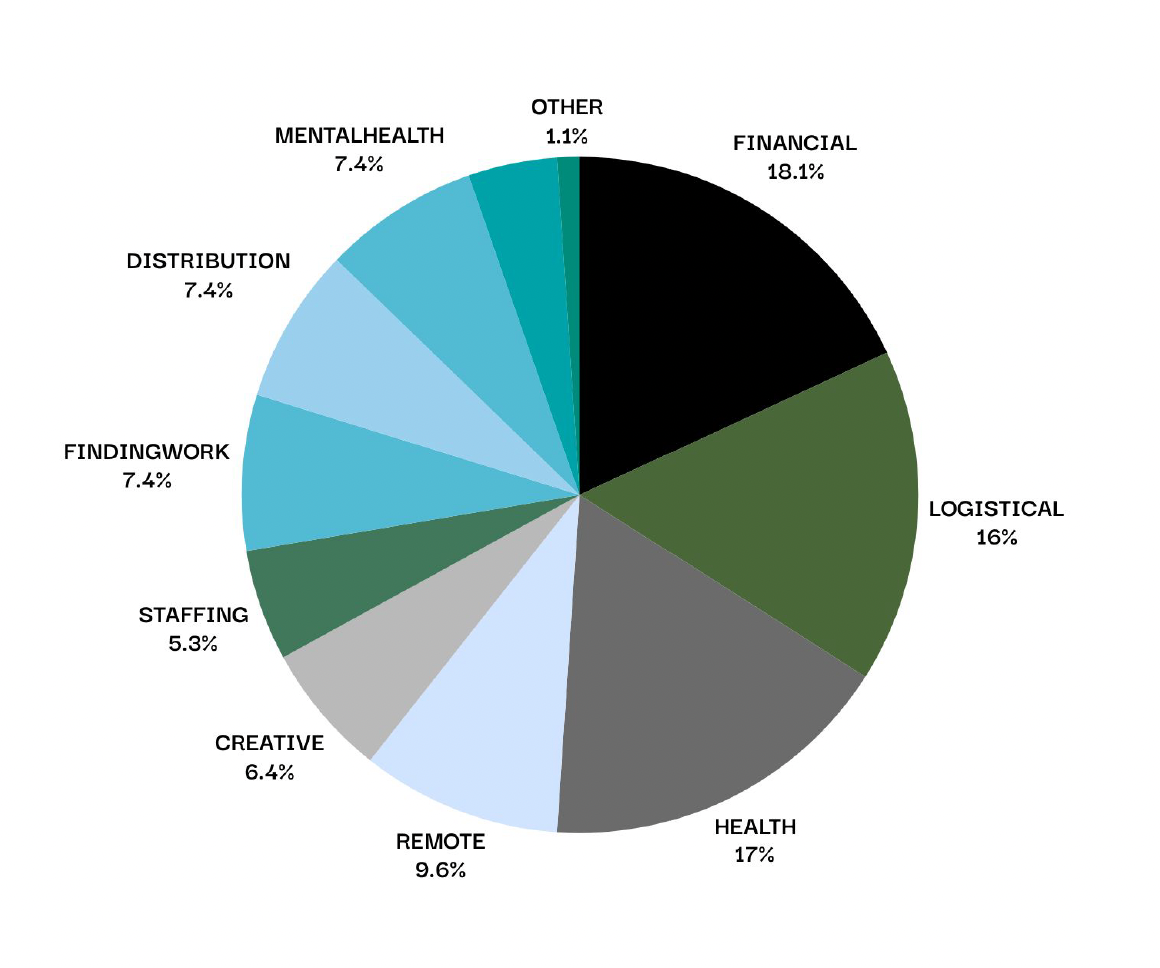
To assess the impact of COVID-19 on film production, respondents were asked to identify the most significant challenges they faced in their roles. They could select from the following options:
Health and safety concerns
Financial constraints, income, and financial struggles
Logistical challenges (travel, mobility restrictions)
Adapting to remote collaboration, remote filmmaking, post-production, technology challenges (online events), VR/AR
Creative restrictions (script changes to accommodate social distancing, limit on actors and crew on set, etc.)
Crew, cast, and staffing issues
Difficulty finding work
Distribution and exhibition strategy changes (increased VOD demand, cinema closures)
Mental health and well-being
Audience behavior (viewer preferences)
Other: [Specify]
Additionally, respondents were asked to describe any unexpected opportunities that emerged due to the pandemic’s impact on film production and to explain the changes in their daily work, including any new methods or tools they were using.
Best Practices
The questionnaire sought to uncover the best practices and innovative strategies adopted to navigate the challenges posed by the pandemic. Respondents could select from the following:
Collaborative work in cloud solutions
Implementing new production workflows: virtual location scouting, VP, generated environments, and green screen
Crew, cast, and staffing issues (online casting, digital audiences)
Exploring streaming and online distribution
Open-air events
Adapting scripts for flexibility (AI-supported script writing)
Prioritizing mental health support
Enhancing communication within the team
Diversifying revenue streams with partnerships
Adjusting budgets for financial constraints
Developing flexible contingency plans
Digital audiences, online casting
None
Other: [Specify]
Sustainable Growth Factors
Respondents were asked to rank factors contributing to sustainable growth in the film production industry, including:
Adaptability to technology
Strong financial management
Global collaboration
Sustainable and green practices
Effective marketing
Audience engagement
Quality education
Government support
Cultural relevance
Transparency and ethics
Inclusivity
Other: [Specify]
They were also asked to what extent these factors had been influenced by the COVID-19 pandemic, using a ranking scale of 1-5.
Benefits for Small European Nations
To explore the unique advantages of small nations in adapting to crises like the COVID-19 pandemic, respondents were asked to agree or disagree with the statement: “Being a small nation provides an advantage in adapting to unforeseen challenges such as the COVID-19 pandemic,” using a Likert scale of 1-5.
They were also asked to rank the advantages of small markets, including:
Quicker to adapt
Fast decision-making
Empathy and personal relations, cohesiveness
Understanding and comprehension of the issues
Flexibility and openness to changes, customization
Cost efficiency
Other: [Specify]
Respondents were encouraged to share examples of how being a small nation facilitated their ability to adjust and innovate during the pandemic.
Market Outcomes
To gauge the outcomes experienced by different segments of the film industry due to the COVID-19 pandemic, respondents were asked to rank the following markets on a scale of 1 (very negative) to 5 (very positive):
Video on Demand (VOD)
Animation and Visual Effects
Cinemas
Film Festivals
Tech and Virtual Production
Regular Film Production
Documentaries and Non-fiction Content
Independent Filmmakers, Short Films, Niche and Genre Films
Market environment (journalism, critics, education, etc.)
Other: [Specify]
They were also asked to indicate changes in audience preferences due to the pandemic, ranking their agreement with statements such as:
Streaming Dominance: A shift towards streaming services
Home Theatre Focus: Increased emphasis on home entertainment
Escapist Genres: Growing interest in escapist genres (fantasy and science fiction)
Cinema Cautiousness: More selective about cinema attendance
Shorter Content: Preference for shorter formats
Documentary Appeal: Rising interest in documentaries
Nostalgia: Rediscovering and enjoying classic films
Looking Ahead: Policy Recommendations
To enhance the resilience and adaptability of the film production industry during crises, respondents were asked about necessary policy changes or initiatives. Options included:
Crisis response funds
Insurance and risk mitigation
Collaborative production networks
Incentives for digital innovation
Crisis preparedness training
Diversity and inclusion initiatives
Environmental sustainability measures
Copyright protections (digital)
Ecosystem building and support (clusters, cooperation, forums)
Justice transformation - solidarity fund, cross-industry sustainable change mechanism supporting groups losing in transition
Flexible labor regulations (hybrid work, working conditions, hours, adaptation of labor law provisions)
Openness to new workflows and use of the public domain in film production (virtual film settings)
Remote education and future-proof skilling
Respondents were also asked how the industry could sustain the positive changes that emerged from the pandemic and foster growth, providing their insights in an open-ended format.
Who Filled Out the Survey?
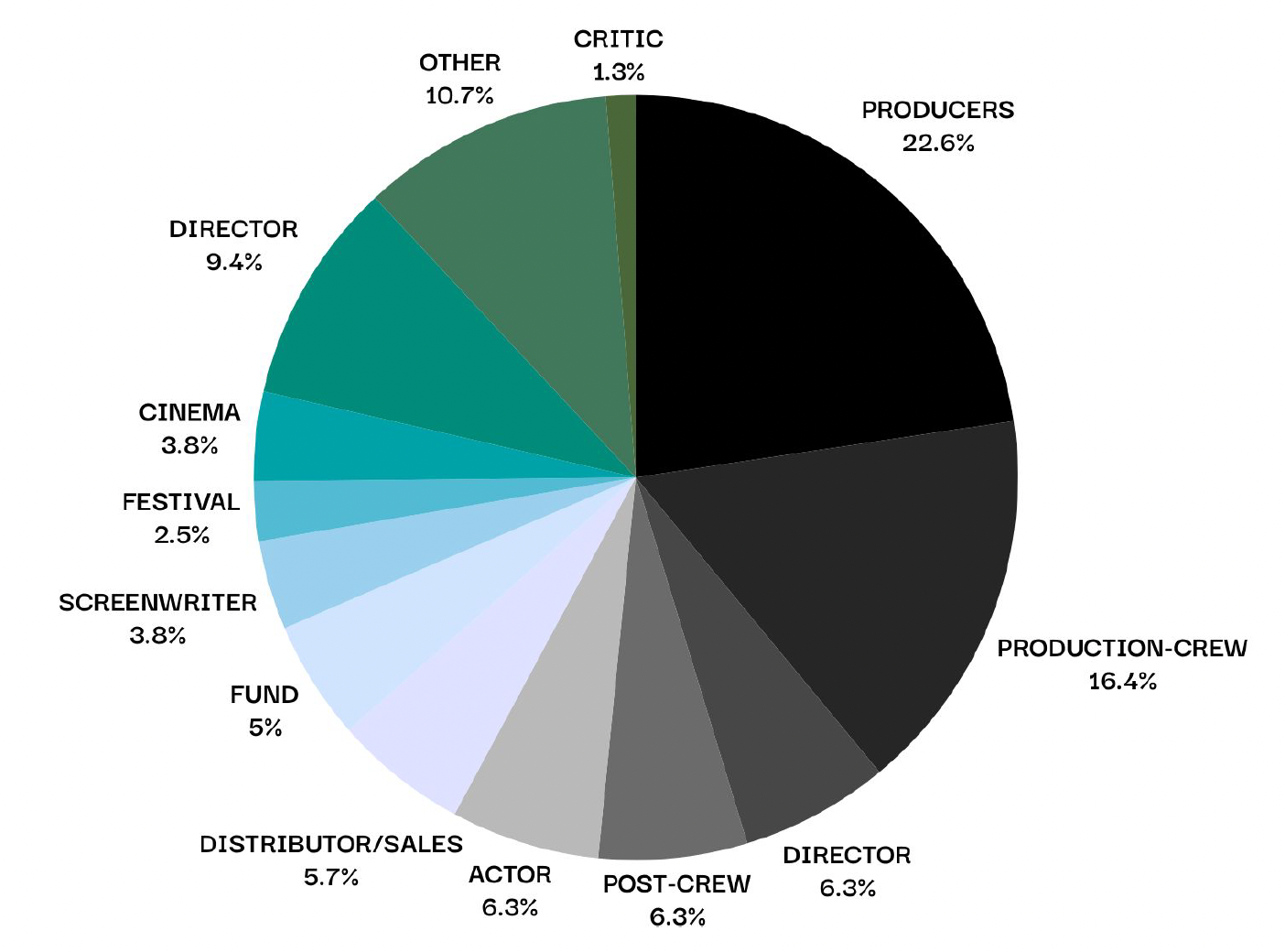
The survey was shared by each partner of the consortium in their respective markets, with the support of universities and industry players. The most significant contribution came from EFA, who distributed the survey among their members. In total, there were 175 responses, but it is important to note that the majority were from small markets, so a smaller sample size is expected.
Notably, 60% of respondents indicated that their represented market segment has experienced negative outcomes from COVID.
Follow-up Interviews
The next step involved follow-up interviews with 25 respondents, informed by the analyzed survey data. We formulated key follow-up questions and ensured a balanced representation from each market, covering the entire
production pipeline. These semi-structured interviews, conducted online with film industry professionals, lasted 45-60 minutes. The goal was to identify approaches to handling crises and lessons for the future.
Interview highlights:
Personal impact: How the pandemic affected careers, project evolution, and outcomes.
Film project impact: Changes to scripts, production, and logistics due to COVID-19, including new technologies and distribution strategies.
Success stories: Adaptations and innovative strategies implemented during the pandemic.
Case studies: Examples of successful industry responses to the pandemic.
Distribution strategies: Shifts in distribution and exhibition methods, especially with increased VOD demand.
Production examples: Projects developed or shot during COVID-19 and their adaptations.
Tools and technologies: New tools or methods adopted due to the pandemic.
National advantages: Unique opportunities or growth factors resulting from the pandemic.
Local industry evolution: How the local industry landscape changed and the new opportunities that arose.
Small nation advantages: Benefits of being in a small market during the pandemic.
Government policies: Impact of government policies on industry recovery post-COVID.
COVID-19: Perfect Storm Effect for Small Film Markets
Trigger for digital transformation
Pandemic hit amidst ongoing industry changes
Acted as a booster, accelerating existing changes
Exposed the strengths and weaknesses of businesses
Highlighted the need for stronger and more flexible systems
What Were the Key Challenges in Your Role?
Healthcare
Reliance on local and EU funding, with appreciated quick crisis responses, clear communication and flexibility.
Diversified income streams minimized impact; others began diversifying or starting new businesses.
Exposed strengths and weaknesses, prompting reflection on future essentials.
“They were very responsive. <...> they had new findings to help us out. They also allowed to renegotiate deadlines and things. <...>I told you we are very dependent for all public funding, so it was great”
Producer, Portugal
“I edited a series about COVID-19. I’m also teaching <...> Although commercial work has ceased, this period has allowed me to diversify my activities, and I enjoyed the less hectic pace and more flexible deadlines.”
Editor, Lithuania
“A period to reflect on the business and what was essential for the future.”
Producer, Ireland
“Our investment in virtual studio applications of the last 12 years started to pay off.”
Film industry infrastructure representative, Flanders
Many professionals in the film industry faced severe financial strain due to halted projects and reduced funding opportunities during the COVID-19 pandemic. The crisis exposed the fragility of existing financial structures, prompting a rethinking of funding and revenue strategies. The reliance on local and EU-level support became increasingly evident, with quick, flexible responses from funding bodies proving crucial. Clear communication and the ability to renegotiate deadlines provided essential relief, enabling projects to continue under new constraints.
In smaller the dependence on public funding was particularly pronounced. As one Portuguese producer noted, “They were very responsive…they had new findings to help us out. They also allowed us to renegotiate deadlines…We are very dependent on public funding, so it was great.”
For some, the pandemic became a catalyst for diversification. An editor from Lithuania shared, “I edited a series about COVID-19. I’m also teaching…Although commercial work has ceased, this period has allowed me to diversify my activities.” Similarly, a producer from Ireland reflected, “It was a period to reflect on the business and what was essential for the future.”
Moreover, the crisis highlighted the value of long-term investments in innovation. A representative from the Flanders film industry noted, “Our investment in virtual studio applications over the last 12 years started to pay off.”
While the pandemic underscored the weaknesses in financial structures, it also revealed strengths, prompting many in the industry to rethink their approaches and embrace more resilient strategies for the future.
Logistical Challenges & Remote Opportunities
Opened many doors, but the industry craves face-to-face interactions.
Online meetings are greener for technical discussions but fall short for creative interactions.
Crews in small markets faced disruptions. While more local crew available on site, remote-friendly positioned workers pursued higher-paying remote opportunities.
Blurred the lines between professional and private life.
Industry is rethinking the balance between remote and in-person work.
“You know, when somebody suggests, let’s meet on Zoom, or teams or something, I feel like I’m gonna throw up. We are all yearning for for face to face.”
Film producer, Croatia
“I was selected to participate in Script Lab Story Editing within TorinoFilmLab <...>I believe that nobody truly benefited from the workshop as much as they would have if the entire workshop had been held in person.”
Screenwriter, Croatia
“Using home as an office, the transition from professional to private was sometimes non existent. We became more available and non stop working.”
Editor, Croatia
“Major studios <...> started working more with remote workers. And that was bad for us because they pay more money, they can give more stability to workers. So a lot of people start working remotely for those big studios.”
Animation producer, Portugal
However, this period also revealed the industry’s resilience and capacity for innovation. The pandemic accelerated the adoption of digital tools and remote work, enabling filmmakers to continue their work despite physical restrictions. Virtual production techniques, remote collaboration platforms, and digital distribution channels became essential tools, opening new avenues for creativity and efficiency.
Yet, the shift wasn’t without its challenges. Smaller markets, in particular, struggled with limited resources and access to technology. The uneven playing field became more apparent, as some regions adapted more swiftly than others. Additionally, while digital tools opened many doors, the industry still craved face-to-face interactions. As a film producer from Croatia expressed, “When somebody suggests, ‘Let’s meet on Zoom or Teams,’ I feel like I’m gonna throw up. We are all yearning for face-to-face.”
The pandemic forced the film industry to rethink its traditional ways of working, leading to a surge in creative adaptations. Living rooms became editing suites, and home offices transformed into production hubs as remote work became the norm. This shift blurred the lines between professional and private life, with one Croatian editor noting, “Using home as an office, the transition from professional to private was sometimes nonexistent. We became more available and nonstop working.” Remote collaborations became a hallmark of this period. Teams spread across different continents managed to work together through video calls, cloud-based editing, and virtual production meetings. These innovations allowed projects to move forward without the need for physical presence, demonstrating the industry’s resilience.
However, as a screenwriter from Croatia observed, online meetings may be greener for technical discussions but fall short for creative interactions: “Nobody truly benefited from the workshop as much as they would have if it had been held in person.” Moreover, the rise of remote work created new challenges for smaller markets. While local crews became more available on-site, remote-friendly professionals pursued higher-paying opportunities with major studios abroad. An animation producer from Portugal remarked, “Major studios started working more with remote workers. That was bad for us because they pay more and offer more stability, so a lot of people started working remotely for those big studios.”
The industry is now rethinking the balance between remote and in-person work, recognizing both the opportunities and limitations of the digital shift. While the pandemic opened new doors, it also underscored the enduring value of face-to-face collaboration in fostering creativity and maintaining the industry’s unique culture.
Time for Creative and Strategic Reset
Renewed focus on thorough project development and refining, resulting in higher quality scripts and productions.
Completion of long-delayed passion projects, leading to a creative reset.
“Because we were not able to travel, <...> to attend markets, we were able to develop some of those films really, really well. There is a <...> film that we are developing now for four years. But now, the script is so perfect.”
Producer, Croatia
“During the Covid, specially during the first confinement, I found out that I had time to spend in projects that were put apart before, because lack of time.”
Film critic, Portugal
The pandemic, while challenging, offered a rare opportunity for a creative and strategic reset in the film industry. With travel restrictions and the cancellation of in-person events, filmmakers had the chance to focus deeply on project development and refinement, leading to higher quality scripts and productions. This period of introspection and uninterrupted work allowed many to revisit and complete long-delayed passion projects, resulting in a renewed creative energy.
As a Croatian producer reflected, “Because we were not able to travel or attend markets, we were able to develop some of those films really, really well. There is a film we have been developing for four years, and now the script is so perfect.” Similarly, a film critic from Portugal noted, “During the first confinement, I found that I finally had time to spend on projects that were put aside before due to lack of time.”
This forced pause led to a creative resurgence, where the focus on thorough development processes not only enhanced the quality of current projects but also set a new standard for future productions. The industry’s temporary slowdown became a catalyst for deeper creative exploration and strategic planning, ensuring that the stories emerging from this period are more refined and impactful than ever before.
Adapting to New Future And Skills
Respondents observed the shift from cinema to VOD with mixed emotions, with some reluctant to change and hoping for cinema’s return, but overall recognizing the need to adapt.
The pandemic accelerated learning about new technologies, prompting even older film professionals to adopt them.
“No one could foresee that the temporary shift of audiences from theaters to home would be used to make streaming services the main distribution channel. This change happened silently, in the background, without any obvious conflict between streamers and theaters. It was like putting nails in the coffin of traditional theaters.”
Post production lead, Portugal
“I could learn about Virtual production.”
Cinematographer, Flanders
“I learned to edit remotely, discovered an app <...>I guess I would have discovered it anyway, but COVID just forced that shift.”
Editor, Lithuania
“Since in Croatia, average age of film professional is around 60, we did start using new technologies during pandemic.”
Crew member, Croatia
The pandemic forced the film industry to confront and adapt to a rapidly changing landscape, particularly the shift from traditional cinema to Video on Demand (VOD). This transition was met with mixed emotions among industry professionals. While some remain reluctant to embrace this change, holding onto hopes for cinema’s resurgence, there is a widespread recognition of the need to adapt to the new reality.
As a post-production lead from Portugal observed, “No one could foresee that the temporary shift of audiences from theaters to home would be used to make streaming services the main distribution channel. This change happened silently, in the background, without any obvious conflict between streamers and theaters. It was like putting nails in the coffin of traditional theaters.”
Alongside this shift, the pandemic accelerated the adoption of new technologies across the industry. Even older film professionals, who might have been slower to embrace these advancements, found themselves learning and adapting out of necessity. A crew member from Croatia noted, “Since in Croatia, the average age of a film professional is around 60, we did start using new technologies during the pandemic.”
This period also became a time of skill-building for many. A cinematographer from Flanders shared, “I could learn about Virtual production,” while an editor from Lithuania mentioned, “I learned to edit remotely, discovered an app… I guess I would have discovered it anyway, but COVID just forced that shift.”
As the industry moves forward, the lessons learned and skills acquired during this time will be crucial in navigating the evolving landscape of film production and distribution. The shift to VOD and the rapid adoption of new technologies have reshaped the industry, and professionals are now better equipped to thrive in this new era.
The Advantage of Being a Small Nation in Adapting to Unforeseen Challenges
The COVID-19 pandemic tested the resilience of industries worldwide, and the film industry was no exception. For smaller nations, the question arises: does being a small nation offer an advantage in adapting to unforeseen challenges like the
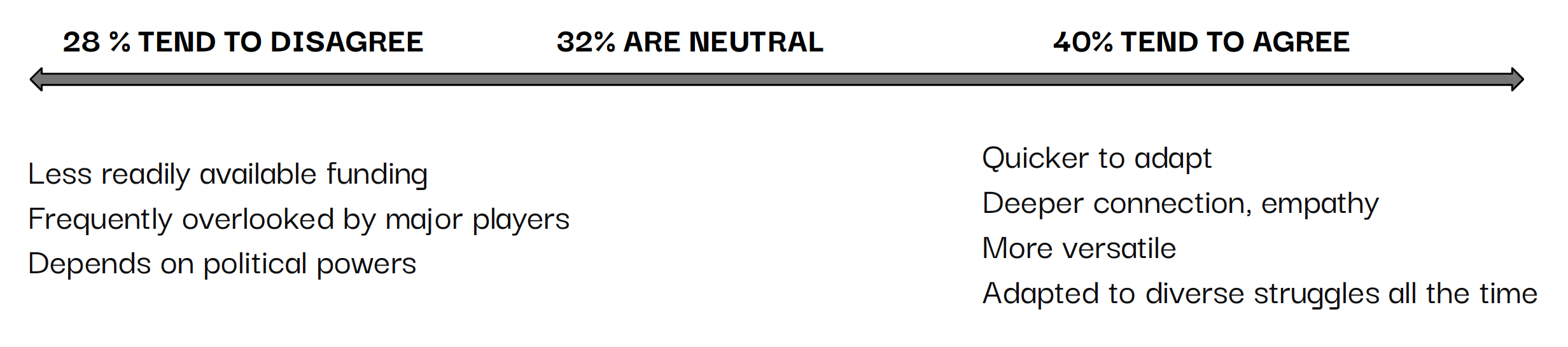
pandemic? The perspectives on this issue are varied, with industry professionals expressing a range of opinions. According to survey results, 40% of respondents tend to agree with the statement that being a small nation provides an advantage in such situations, 32% remain neutral, and 28% tend to disagree.
Why Some Disagree
A significant portion of respondents, 28%, tend to disagree with the idea that being a small nation is advantageous in navigating crises like the COVID-19 pandemic. One of the primary reasons cited is the challenge of accessing adequate funding.
Smaller nations often have less readily available financial resources, making it difficult for filmmakers to sustain their projects during prolonged disruptions. This lack of funding can be exacerbated by the fact that these nations are frequently overlooked by major international players, who tend to focus on larger markets with greater economic clout.
Furthermore, the ability to adapt in smaller nations can be heavily influenced by the political landscape. The dependence on political powers for support and resources can create uncertainty, as government priorities may shift, especially in times of crisis. If the political leadership is not aligned with the needs of the creative sector, the film industry may struggle to secure the necessary backing to navigate through challenges.
Why Others Agree
Conversely, 40% of respondents tend to agree that being a small nation offers unique advantages in adapting to unforeseen challenges. One of the key reasons is the ability to adapt more quickly. Smaller nations often have less bureaucracy and more streamlined decision-making processes, allowing them to implement changes rapidly in response to new circumstances. This agility can be crucial in times of crisis when quick responses are needed to mitigate the impact on the industry.
Additionally, smaller nations often benefit from a deeper sense of community and empathy within the industry. The closer connections among professionals can foster a collaborative environment where individuals support one another through difficult times. This sense of solidarity can enhance the overall resilience of the industry, making it easier to pull together resources and find creative solutions to challenges.
Moreover, professionals in smaller nations tend to be more versatile out of necessity. With fewer resources and opportunities, they often wear multiple hats and are accustomed to adapting to a variety of roles and challenges. This versatility can be a significant asset when navigating the complexities of a crisis like the COVID-19 pandemic.
Another point in favor of small nations is their historical adaptation to diverse struggles. Many smaller nations have faced various economic, political, and social challenges over time, which has cultivated a culture of resilience and innovation. This history of overcoming adversity can make them more adept at navigating new crises.
Neutral Perspectives
The remaining 32% of respondents are neutral on the issue, indicating that they see both pros and cons or that the impact of being a small nation in such situations is context-dependent. For these respondents, the advantages and disadvantages may balance out, or they may believe that other factors, such as global market dynamics or the nature of the crisis, play a more significant role than the size of the nation.
How do you agree with the statement:
‘Being a small nation provides an advantage in adapting to unforeseen challenges, such as the COVID-19 pandemic?’
What Will Help Us or Fail Us In Our Transformation?
“In our eagerness to draft a film protocol for the government as swiftly as possible, to facilitate a prompt return to work, various professional groups and producers were compelled to convene hastily and collaborate on its formulation. This process has enlightened many, even beyond the COVID-19 crisis, to the realization that such exchanges among the diverse stakeholders active in the Audiovisual sector constitute a stride towards improved communication among these disparate groups.”
“Being a small nation means that you are frequently overlooked by the big market players. Ireland lost business to some of the other countries that opened up more quickly post/during.”
“Smaller nation not always makes decision quicker, it depends also on political side in a country and how everyone is align to help their country.”
“There perhaps is a deeper connection and a ‘everyone-knows-everyone’ mentality so we watch each other’s back and more willing to do what’s right for each other in adapting to the challenges of COVID.”
“In post-production, there’s a plus to being small. There are big companies abroad, there are established workplaces where everyone works for 20 years, to change something you have to train a lot of people who don’t want change. We are more versatile because everybody is freelance. But of course our production level is low, it doesn’t require the creation of big companies. the films are more ordinary. they are not necessarily bad, but they are simpler.”
“We do not have as much readily available funding to adapt to the challenges or covid as larger countries who were able to return more readily as they had more financial backing for covid testing, contingency plans and adaptability such as housing crew during productions. etc.”
“Funding is lacking already, so an extra cost and logistic challenge like COVID is not easy to accommodate.”
“The smaller industries allow for closer collaboration and the feeling that we’re all in this together.”
A small nation is adapted to diverse struggles all the time. It has to be creative to solve problems when there are financial issues.”