

Film Production Cooperation in Europe Between Regional and Transnational Alliances

Executive Summary
Deliverable D5.1 analyses how film production cooperation can be initiated and sustained in small European film markets within the CresCine project (Horizon Europe, 2023–2026). It addresses structural fragmentation in SME-dominated, project-based production ecosystems and positions cooperation as a practical mechanism to strengthen competitiveness and long-term sustainability.
The deliverable documents two pilots: (1) a regional cooperation alliance in Croatia, a small market without a formalised production cluster, initiated through an industry workshop in Zagreb (26 August 2024) and followed by staged cluster pre-formation steps including a Memorandum of Intent; and (2) a transnational cooperation framework, formalised as the CresCine Alliance through a Collaboration Agreement signed at the European Film Market (Berlin, 14 February 2026), defining governance, coordination roles, and long-term objectives.
Methodologically, D5.1 combines Participatory Action Research with cluster mapping (including ECCP), semi-structured interviews (Filmby Aarhus, TWIST, Catalan Audiovisual Cluster, BFCT), comparative desk research, and iterative implementation feedback. Key outputs include documented pilot processes and practical recommendations on staged institutionalisation, coordination capacity, and funding alignment for building sustainable regional clusters and scalable transnational alliances.
Statement of Originality
This deliverable contains original unpublished work except where clearly indicated otherwise. Acknowledgement of previously published material and of the work of others has been made through appropriate citation, quotation, or both.
Disclaimer
The European Commission’s support for the production of this publication does not constitute an endorsement of the contents, which reflect the views only of the authors, and the Commission cannot be held responsible for any use which may be made of the information contained therein.
Context, Scope, and Methodology
1.1 Crescine, project objectives
CresCine is a research and innovation project funded by Horizon Europe (2023–2026) and led by Lusófona University in Portugal. The primary objective is to enhance both the competitiveness and cultural diversity of the European film industry, with a particular focus on smaller film markets. These smaller markets, present in most EU countries, encounter challenges such as limited resources, fragmented structures, and significant dependence on public funding. Nevertheless, they present substantial opportunities for creativity, cultural expression, and flexible production methods.
As the race for technological leadership and geo-economic rivalries intensify, the European Union needs to make the most of its greatest source of power: the Single Market. Building on the analysis and recommendations of last year’s Letta and Draghi reports, the European Commission has outlined its economic policy agenda in the Competitiveness Compass47, the Clean Industrial Deal48, and the Single Market Strategy. The Single Market is not flat but is shaped by the industrial agglomerations that make up its economic substance. Cluster organisations are the institutional representation of this competitiveness landscape.
Competitiveness stands at the centre of Porter’s well-known conceptualisation of clusters.50 In this view, competitive advantage in the modern economy rests neither on the performance of individual firms nor on macroeconomic interventions, but on the strength and connectivity of the localised networks. Clusters enhance productivity by enabling firms to access specialised inputs and talent; they drive innovation through intense local rivalry and cooperation; and they stimulate new business formation by lowering barriers to entry. In today’s European context, cluster organisations thus serve as the institutional superstructure of industrial.
The CresCine consortium comprises 18 full partners, including Lusófona University as the coordinator, and 10 associate partners from across Europe. The network encompasses universities, screen agencies, production companies, innovation clusters, and major pan European organizations such as the European Film Academy and the Marché du Film at Cannes. Pilot countries include Estonia, Lithuania, Denmark, Ireland, Flanders (Belgium), Croatia, and Portugal, representing a diverse range of media landscapes, cultures, and industry development levels. This diversity enables in-depth analysis of national contexts and facilitates comparative assessment of cross-border trends.
Deliverable 5.1 contributes to CresCine’s objectives by piloting two distinct models of production cooperation:
1. A regional production cooperation alliance in a small European country that currently lacks a formalised production cluster; 2. A transnational cooperation alliance, connecting stakeholders across multiple small-market countries to promote knowledge exchange, joint portfolios, collective marketing, and resource sharing.
These pilot projects are both intended to test cooperation in practice and to develop practical guidelines and a clear, step by step plan for establishing film production alliances at local, national, and international levels that are tailored to the specific realities of small markets.
The Baltic Film and Creative Tech Cluster (BFCT), based in Vilnius, Lithuania, leads this component of the project. BFCT connects companies and organizations engaged in film, audiovisual services, and creative technologies. The cluster plays a central role in fostering innovation, facilitating collaboration among small and medium-sized enterprises, and developing international partnerships within the Baltic region. Drawing on extensive experience in alliance formation and EU project management, the BFCT team is well positioned to design and implement both pilot models.
1.2. Deliverable objectives and scope
Deliverable 5.1 documents and analyses two pilot production cooperation alliances initiated within the CresCine project: a regional alliance in a small European market lacking a formal cluster structure, and a transnational alliance connecting multiple small-market ecosystems.
Specifically, the deliverable aims to:
Design and initiate a regional production cooperation alliance under real market conditions;
Develop and test a transnational cooperation model for small European film markets;
Identify organisational, coordination, and funding requirements necessary for sustainable alliance development;
Formulate transferable guidelines and an implementation roadmap for establishing regional and international production alliances.
The analysis is structured around four core implementation questions:
How can production cooperation be initiated and stabilised in small markets where no formal cluster currently exists?
What governance and coordination mechanisms are necessary to sustain SME-based cooperation in project-driven industries?
Under what conditions can regional alliances scale into effective transnational cooperation structures?
How can funding strategies be aligned to ensure long-term sustainability beyond project-based cycles?
1.3 Methodology
The methodology combined qualitative research with hands-on pilot projects, employing a Participatory Action Research approach. Researchers and industry players collaborated directly to identify challenges, test various cooperation methods, and derive insights from ongoing processes. This approach ensured active engagement in real industry contexts at both national and international levels.
The methodological framework consisted of interrelated components:
1.3.1. Mapping
As a preliminary step, the mapping exercise was conducted to identify existing audiovisual, media, and creative industry cluster organisations and related cooperation structures across Europe. The mapping combined:
a systematic review of European cluster directories, including the European Cluster Collaboration Platform (ECCP);
consultation of national audiovisual agency listings and industry association databases in the pilot countries;
screening of partner-provided networks and prior EU-funded project consortia;
analysis of publicly available organisational documents, including statutes, membership structures, governance models, and activity reports.
The mapping served two purposes: (1) to establish an empirical overview of the cluster landscape relevant to audiovisual cooperation; and (2) to support purposive sampling for interviews by ensuring variation across governance logics (bottom-up vs. top-down), organisational maturity, and territorial/policy contexts.
Based on this mapping, a small set of cases was selected for semi-structured interviews to represent distinct organisational models and regional environments.
1.3.2 Semi-structured interviews
A total of four semi-structured interviews were conducted between June and August 2025 with senior representatives of established European audiovisual cluster organisations. Interviewees included cluster directors, board-level representatives, and coordination managers responsible for governance, strategy, and international cooperation.
The interview sample comprised representatives of Filmby Aarhus (Denmark), TWIST Cluster (Wallonia, Belgium), the Catalan Audiovisual Cluster (Catalonia, Spain), and the Baltic Film & Creative Tech Cluster (Lithuania). Cases were selected through purposive sampling to ensure variation across bottom-up industry-driven initiatives and top-down policy-supported models, different stages of organisational maturity, and diverse regional economic and policy environments within small and medium-sized European markets.
Interviews focused on governance structures, funding models, coordination mechanisms, stakeholder engagement practices, and challenges related to both regional cluster formation and transnational alliance development. All country examples cited in this report derive from these CresCine interviews (Task 5.4, 2025) and serve as comparative reference points informing the design and interpretation of the Croatian regional pilot and the CresCine transnational alliance.
This comparative design provides qualitative insights into operational conditions and structural tensions shaping cooperation sustainability in SME-dominated audiovisual ecosystems.
Limitations. The interview sample is limited to four cluster-level organisations and does not include individual production companies or public authorities as primary respondents. Access constraints and the focus on small-market ecosystems limit the analytical scope and reduce the direct transferability of findings to larger or structurally different European markets. The inclusion of BFCT as both consortium partner and interviewee reflects a reflective practitioner perspective rather than an external case study.
1.3.3. Regional cluster initiation pilot (Croatia)
A focused industry workshop was held in Zagreb on 26 August 2024 with Croatian film producers as part of the regional pilot process. Croatia was selected as consortium partner member in the need of cluster. Well established Croatian film producer 14
Danijel Pek was the main initiator of the clustering activities. Instead of serving merely as a presentation of an external cluster model, the workshop functioned as the initiating stage of a potential national cluster formation process. Its primary objective was to collectively diagnose structural bottlenecks within the Croatian production ecosystem and assess stakeholder readiness for more formalised cooperation.
Co-facilitated by representatives of the Baltic Film and Creative Tech Cluster (Lithuania), the session combined practical governance insights with structured discussion around coordination needs, funding constraints, and long-term sustainability. The workshop marked the transition from informal dialogue to structured pre-formation steps.
Building on workshop discussions, comparative desk research, and interview insights, a set of preliminary cluster development steps was outlined. These included defining shared objectives, identifying a potential coordinating body, clarifying membership principles, and assessing funding pathways. As an intermediate institutional instrument, a Cluster Initiative Agreement (Memorandum of Intent) was drafted to formalise intent, articulate cooperation objectives, define governance roles, and provide a framework for future institutionalisation pending sustainable funding and administrative capacity.
1.3.4. Transnational alliance institutionalisation
Parallel to the Croatian regional pilot, the project advanced the formalisation of a transnational cooperation framework by establishing the CresCine Alliance. Building on collaboration developed during the Horizon Europe project, participating organisations formalised their commitment to continued cooperation by signing a Collaboration Agreement during the Crescine General Assembly and closing event at the European Film Market (Berlin, 14 February 2026).
The CresCine Alliance constitutes a formally established transnational framework with defined governance arrangements, strategic directions, and long-term objectives. The agreement establishes a lead partner, a steering committee composed of representatives from all partners, appointed collaboration managers within each organisation, and an explicit commitment to sustained engagement with the European Commission.
1.3.5. Comparative desk research
A targeted review of European cluster policy, audiovisual cooperation models, small-market industry structures, and transnational governance frameworks provided the analytical foundation for interpreting both pilot processes. The desk research contextualised empirical findings within broader debates on SME competitiveness, cluster governance, cultural policy, and transnational cooperation.
1.3.6. Implementation feedback
Continuous exchanges within the CresCine consortium ensured that findings were regularly tested against practical implementation constraints and evolving stakeholder positions. This iterative feedback loop strengthened the reliability of conclusions and allowed adjustments in real time as cooperation structures evolved.
Structural Context: Policy Foundations and Cooperation Models in Small European Film Markets
2.1 Rationale for cooperation in small film markets
Small European film markets are characterised by a structural paradox. While creative output and festival visibility remain strong, the organisational and economic foundations of production ecosystems are fragile. Enterprises are predominantly micro and small companies; production is organised around one-off projects; and long-term capital accumulation remains limited. Entrepreneurial risk is rarely absorbed at firm level and is instead deferred through short-term project logic. As a result, growth, innovation investment, and strategic scaling remain structurally constrained.
Under such conditions, cooperation emerges as a structural response. Regional clusters and, at a later stage, transnational alliances allow companies to pool resources, share infrastructure, and extend their strategic horizon beyond individual productions. By creating collective coordination mechanisms, they can reduce transaction costs, facilitate knowledge exchange, and enable access to funding instruments that remain out of reach at single-company level. In SME-dominated film ecosystems, cooperation thus functions as entrepreneurial infrastructure rather than mere networking.
Cluster theory provides a governance-oriented framework for addressing this challenge. Porter (1998; 2008) conceptualises clusters as geographically proximate systems of interconnected firms and associated institutions that combine competition with structured cooperation. However, subsequent work has demonstrated that cluster dynamics increasingly hinge on multi-scalar relational architectures that are not confined to territorial agglomeration alone. Bathelt, Malmberg and Maskell (2004) conceptualise clusters as assemblages of “local buzz” and “global pipelines”, highlighting how strategic, often formalised alliances with distant partners become integral to knowledge creation and upgrading. In parallel, research on temporary clusters and trade-fair circuits shows that episodic, spatially dispersed meeting places can function as crucial interfaces that complement or even substitute permanent co-location. From this perspective, clusters can be understood as governance arrangements embedded in wider global production and innovation networks, where geographically non-contiguous, cognitively and organizationally proximate actors co-produce value through coordinated, yet non-hierarchical, alliances. Such an understanding aligns cluster theory with global production network and global value chain scholarship, which likewise frames firms as competing and cooperating across dispersed locations through networked forms of coordination rather than purely localised agglomerations. In practice, clusters reduce fragmentation by coordinating value-chain complementarities and integrating firms with research institutions and public authorities. The cluster initiative (CI) literature further demonstrates that durable cooperation depends on intermediary capacity, defined governance rules, and staged institutionalisation (Sölvell et al., 2003; Lindqvist et al., 2013). Without such anchoring, collaboration tends to remain episodic and project-bound.
This structural need has been progressively recognised at European policy level. Since the 2006 EU Competitiveness Council conclusions, clusters have been positioned as instruments for enhancing innovation and SME competitiveness. Subsequent frameworks including the Lisbon Strategy and Europe 2020, embedded cluster logic within broader regional development and knowledge-based growth agendas. Today, cluster development is supported through instruments such as Smart Specialisation Strategies (S3), Horizon Europe, COSME, and the European Cluster Collaboration Platform (ECCP), reflecting an institutionalisation of cooperation as a governance tool.
Against this structural, policy, and theoretical background, CresCine approaches cooperation as staged ecosystem governance. Regional cluster initiatives aim to stabilise national production systems by increasing organisational density and coordination capacity. Transnational alliances extend this logic beyond domestic market constraints, enabling scaling and strategic positioning at European level. Cooperation, in this framework, is treated as a layered organisational architecture necessary for the long-term sustainability of small European film markets. 16
2.2. Forms of cooperation in film production and distribution
The European audiovisual sector operates through multiple cooperation formats at national and transnational levels. These models differ in structure, scope, and institutional ambition. Distinguishing between them is essential when designing sustainable cooperation frameworks for small markets.
At national level, associations and unions - such as producers’ guilds or audiovisual chambers - primarily serve representative and regulatory functions. Their activities typically include advocacy, professional standard-setting, collective bargaining, and policy negotiation. These organisations are membership-based and often structured vertically around specific professions or sectoral segments.
Networks operate more flexibly and may be informal or semi-formal. They facilitate information exchange, visibility, and occasional cooperation but generally lack permanent governance structures or strategic integration across the value chain.
Strategic alliances are often formed around defined objectives, such as co-production agreements, joint distribution initiatives, market access strategies, or coordinated lobbying efforts. Alliances may operate nationally or transnationally. While effective in achieving specific goals, they frequently remain project-bound unless supported by sustained coordination capacity and diversified funding.
In contrast, clusters represent a systemic and policy-aligned model of cooperation. As defined by Porter (1998), clusters consist of proximate groups of interconnected companies and associated institutions linked by complementarities. Within EU innovation policy, clusters are understood as ecosystem-based governance structures integrating businesses, academia, public authorities, and civil society - often described through the Quadruple Helix framework.
Clusters differ from other cooperation models in their aim to have a coordinated value chain development, shared infrastructure, innovation diffusion, and structured governance mechanisms. In SME dominated sectors such as film production, this systemic integration is particularly relevant.
While associations, networks, and alliances fulfil important roles, they do not necessarily address systemic fragmentation or long-term ecosystem sustainability. Cluster-type governance models, aligned with EU innovation and regional development policy, offer a framework for institutionalising cooperation beyond episodic or niche collaboration.
Within this framework, the CresCine regional pilot in Croatia sought to test the feasibility of initiating a cluster-type governance structure capable of stabilising cooperation in a fragmented small-market context.
Stages of Cluster Initiative Development: The Croatian Case in Practice
Croatia was selected as a pilot case for two primary reasons. First, it represents a small European audiovisual market without a formally established production cluster structure, making it a relevant testing ground for cluster initiation under real structural constraints. Second, the presence of an active producer-led initiative and demonstrated stakeholder interest created favourable conditions for launching a bottom-up cluster formation process aligned with CresCine’s practical experimentation objectives.
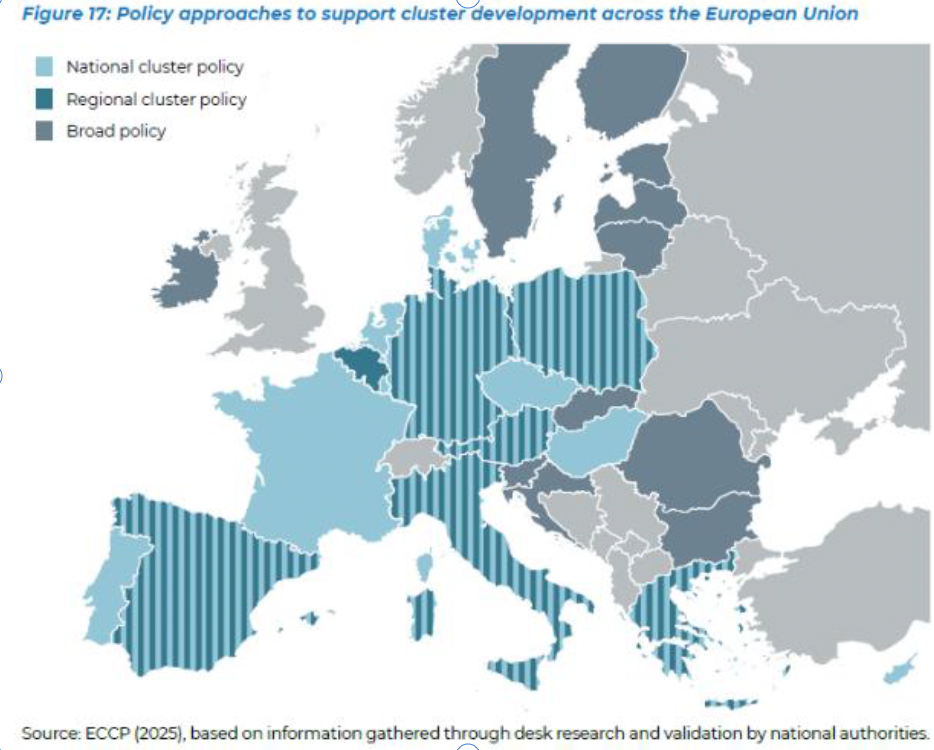
Source: Clusters and Europe's Competitiveness: ECCP Summary Report 2025 | European Cluster Collaboration Platform, p. 39
Cluster formation in small audiovisual markets is rarely a single institutional act. Cluster research conceptualises cluster emergence as a “practice of clustering” built around four key activities: catalysing, coordinating, configuring, and deliberating. Regional actors are shown to use these practices to articulate an envisioned cluster future and to develop shared understandings of how to work together, making some nascent agglomerations evolve into viable clusters while others stagnate. (Stephens & Sandberg, 2020) 19
The following subsections analyse the practical stages through which a regional audiovisual cluster begins to take shape in a fragmented, SME-dominated environment.
3.1. Defining objectives: from structural diagnosis to focused cooperation
The articulation of clear objectives is a critical early step in establishing a regional audiovisual cluster. Research consistently shows that initiatives with a limited number of well-defined goals are more likely to succeed than those attempting to address multiple, loosely connected ambitions (Sölvell et al., 2003). Founders must identify whether the primary objective is to increase sectoral cooperation, strengthen political representation, improve regulatory positioning, facilitate export capacity, support product development, or enable innovation uptake. Without a clearly articulated purpose, a cluster risks becoming a symbolic structure rather than an operational mechanism.
This is particularly relevant in small film markets, where limited resources require cooperation frameworks to be focused, practical, and directly linked to companies’ operational needs. Early-stage clusters that prioritise one or two concrete objectives, such as improving access to finance, strengthening production capacity, or enabling joint market entry - are better positioned to generate tangible value and sustain engagement over time. As a representative of the Catalan Audiovisual Cluster noted,:
“It started not as a cluster, but as a space to speak about common problems. It became clear that being together was the only way to respond to digital change and structural uncertainty” (Catalan Audiovisual Cluster interview, 2025).
In Wallonia, highly specialised companies similarly organised around shared regional strengths to consolidate entrepreneurial capacity and scale their market positioning by forming TWIST cluster. (TWIST Cluster interview, 2025) By contrast, the Aarhus Film City illustrates a top-down pathway, where public investment in infrastructure created the conditions for long-term ecosystem development. (Filmby Aarhus interview, 2025)
Across these models, a consistent pattern emerges sustained engagement depends less on the origin of the cluster than on its ability to deliver concrete entrepreneurial benefits. Companies commit time and resources when cooperation directly addresses constraints they face individually: such as limited access to finance, fragmented production pipelines, or weak bargaining power in international markets.
During the focused industry workshop held in Zagreb on 26 August 2024, conceived as an initiating stage of the Croatian cluster pilot, participants did not articulate a broad cultural or advocacy mission. The workshop brought together Croatian film producers and representatives of other segments of the production pipeline, including professionals engaged in production services and related audiovisual activities. The workshop was explicitly designed as a need-finding and structural diagnosis exercise aimed at identifying practical bottlenecks within the national production ecosystem and assessing readiness for structured cooperation.
Discussions converged around specific structural constraints:
micro-enterprise dominance and limited internal administrative capacity,
fragmented production pipelines,
dependence on project-based public funding,
difficulty accessing EU-level innovation instruments,
limited strategic coordination between domestic production and service production spillovers.
Instead of proposing a comprehensive reform of the sector, producers prioritised a narrow and pragmatic objective: strengthening cooperation along the production pipeline in order to improve capacity, facilitate joint access to EU funding instruments, and enhance long-term sustainability of domestic companies.
Across cases, sustained engagement depended less on institutional design and more on the perceived relevance of cooperation for individual companies’ operational constraints. In Croatia, the initial step of cluster initiation therefore consisted not in creating an organisation, but in articulating a clearly bounded rationale for cooperation.
3.2. Identifying core actors and structuring membership along the production pipeline
Cluster formation in the audiovisual sector does not begin from predefined organisational schemes or policy templates, but from existing patterns of practical cooperation among companies. In the early stages of cluster initiative (CI) development, the initiating actor almost invariably builds on already functioning business relationships, most often among enterprises that cooperate along a shared value chain (Sölvell et al., 2003; Lis & Lis, 2013). The development of the Baltic Film and Creative Tech Cluster illustrates this logic clearly. The cluster did not emerge as a top-down policy construct, but as a response to a practical need to stabilise and sustain an already formed production pipeline. Informal cooperation among producers and their partners existed prior to cluster formation; the cluster initiative formalised these relationships into an organisational structure capable of supporting continuity, innovation, and access to shared resources beyond individual projects. A similar logic informed the Croatian pilot, where discussions during the Zagreb workshop revealed that cooperation needs were already embedded in daily production practices, and the proposed cluster was understood as a way to organise and strengthen these existing dependencies rather than invent new ones.
Finally, cluster membership is voluntary but inherently selective. Cluster organisations typically define entry criteria based on geographical scope, sectoral focus, position in the value chain, innovation potential, or peer recommendation. Such selectivity protects the cluster from unfocused expansion and ensures that cooperation remains strategically coherent rather than inclusive for its own sake.
These findings align with Porter’s conceptualisation of clusters as systems in which competition and cooperation coexist (Porter, 1998; 2008). In his work on clusters and regional competitiveness, Porter describes clusters as geographically proximate groups of interconnected firms and associated institutions linked through complementarities across industries and value chains. From this perspective, clusters function not as neutral networks, but as entrepreneurial infrastructures that enhance productivity, innovation, and competitiveness by enabling firms to share knowledge, specialised inputs, and institutional support. This understanding is particularly relevant for small, SME-dominated European film markets, where collective coordination can compensate for structural fragmentation and limited internal capacity.
3.3. Establishing coordination without premature institutionalisation
Effective coordination is a critical condition for cluster development, particularly in early phases. Cluster research highlights the role of a dedicated coordinator, often described as a facilitator or cluster manager, in organising activities, mediating interests, building trust, and mobilising resources (Sölvell et al., 2003; Lindqvist et al., 2013). In practice, this coordinating function requires an identifiable organisational anchor. Cooperation does not sustain itself without a cluster organisation (CO) acting as a legal and operational entity responsible for facilitation, coordination, and representation. In project-based sectors such as film, where collaboration is frequent but continuity is weak, the CO provides the missing link between episodic cooperation and sustained collective capacity. “Without someone holding the process together, cooperation remains a series of one-off conversations rather than a shared trajectory” (BFCT interview, 2025).
The coordinator role typically evolves over time. In early stages, it is often assumed by a founding actor and later formalised as the cluster matures. However, coordination alone is insufficient without sustained member engagement. Research identifies commitment - both strategic and operational - as a key success factor (Lis & McPhillips, 2016). This includes co-creation of priorities, participation in working groups and joint projects, engagement in international activities, and financial contribution. In SME-dominated sectors, such engagement is essential, as clusters often function as intermediaries enabling access to innovation and funding instruments beyond individual company capacity.
This bottom-up logic is also explicitly articulated by the TWIST Cluster (Wallonia), which describes its governance model as demand-driven:
“It's a very bottom-up approach also. So anytime we create a working group it has to come from a demand from our members. And it's not always easy to make it work, but we try to have at least one member or one enterprise that is taking a leading role in this because the idea is not us telling them what they're supposed to work on. We are a small team so we cannot really coordinate five, six, seven working groups. We have to have at least one enterprise leading that. So for example, we have one on AI and we have an enterprise that is a consultancy specialising in the use of AI to manage data, etc., and they would take a leading role in that.”
The Catalan Audiovisual Cluster similarly describes its internal structure as fluid and member-driven, organised around thematic commissions that evolve over time:
“Well, we are five people working in the cluster administration. They are hired by the cluster. And then we have, of course, the board members and the general assembly. It’s open to participation, structuring in different commissions according to the topics of interest. They have been evolving through time. Some of them just die because they don’t make sense anymore, and some of them reappear with time or new commissions appear. So this is quite ups and downs, let’s say. Sometimes they work very well. For example, right now we have one to promote women in tech. This is working very, very well right now, but some others just don’t work.”
Recent studies further emphasise the stabilising role of leading enterprises and public authorities in maintaining cluster cohesion and preventing fragmentation (Hervas-Oliver & Albors-Garrigos, 2008; Belussi, 2015; Parrilli, 2019). Coordination thus functions less as administration and more as a mechanism for sustaining relational density, shared responsibility, and collective identity.
The Croatian pilot consciously adopted a staged approach. Rather than immediately establishing a legal cluster organisation, participants explored provisional mechanisms of coordination. The draft Memorandum of Intent (MoI) prepared after the workshop serves as an intermediate instrument: it formalises intent and outlines shared objectives without imposing rigid governance structures. This sequencing aligns with the cluster initiative model, in which institutional density grows incrementally. Lis & McPhillips (2016) emphasise that member commitment—strategic and financial—must precede heavy institutionalisation. Croatia’s approach reflects an attempt to balance two risks:
Over-formalisation before value creation → low engagement.
Insufficient coordination → fragmentation and stagnation.
By prioritising facilitation and trust-building, the pilot attempts to consolidate relational density before transitioning to a legally anchored cluster organisation.
3.4 Formalisation of intent: The Croatian cluster initiative memorandum
Following the Zagreb workshop, participating stakeholders agreed that the transition from exploratory dialogue to structured cooperation required an intermediate formal instrument. Rather than immediately establishing a legal cluster organisation, a Cluster Initiative Memorandum of Intent (MoI) (annexed to this deliverable) was drafted as a pre-institutional framework.
The Memorandum does not constitute a legally binding organisation. Instead, it performs three structural functions: – it articulates shared objectives and scope of cooperation, – it defines provisional coordination principles, – and it signals collective intent towards gradual institutionalisation subject to funding and governance capacity.
In cluster initiative theory, such instruments function as trust-building devices. They reduce ambiguity, clarify expectations, and create a minimal coordination architecture without triggering premature bureaucratisation.
The Croatian MoI therefore represents the first formalised milestone in the cluster initiation trajectory. (In Annex)
3.5. Funding alignment and early operationalisation
Since the early 2000s, clusters have been recognised as strategic instruments for innovation, SME support, and regional development, and are therefore supported through dedicated EU and national funding programmes.
In practice, cluster organisations rely on mixed funding models, typically combining four main sources: (1) membership fees, (2) governmental funding at national, regional, or local level, (3) project-based funding, primarily from EU programmes, and (4) income generated from services such as training, consulting, or brokerage activities.
Empirical evidence from the Global Cluster Initiative Survey (GCIS) (2012) demonstrates that public funding plays a decisive role in the early development phases of cluster initiatives, accounting for approximately 54% of total revenues. As clusters mature, reliance on public funding tends to decrease, while own-source revenues increase, particularly through membership fees and service-based income (Sölvell et al., 2003; Lis & Lis, 2015). 23
Across the EU, project-based funding represents the dominant financing mechanism, especially in small and medium-sized markets. Many clusters initially rely on national or regional structural funds, while participation in large-scale international programmes, such as Horizon Europe or Euroclusters, typically becomes feasible only once sufficient administrative capacity and coordination structures have been established. This sequencing reflects the transformation of cluster initiatives from project-based entities into more stable, membership-based organisations over time. This sequencing is not merely procedural but entrepreneurial: project-based cooperation allows companies to collectively absorb risk, engage in innovation-oriented activities, and build organisational capabilities without committing to irreversible investments.
At the same time, membership fees generally remain a secondary but symbolically important source of income, reinforcing commitment and long-term engagement. For example, the Baltic Film and Creative Tech Cluster reports that membership fees account for approximately 10–20% of its annual budget, depending on the year. Complementary public support from national or local authorities further stabilises cluster operations and enables strategic continuity.
Taken together, these findings underline that effective funding strategies for cluster organisations depend on alignment with EU and national policy frameworks, gradual diversification of income sources, and the development of organisational capacity. In small European film markets, where private investment capacity is limited, public and project-based funding remains essential, particularly in the early stages of cluster development.
3.6. Managing structural tensions in small markets
The Croatian case illustrates an additional dimension characteristic of small European film markets: the coexistence of international service production growth and fragile domestic production sustainability. Since the introduction of the rebate system in 2012, Croatia has attracted high-profile international projects, generating significant local expenditure and strengthening technical capacity. Yet stakeholders increasingly debate whether service production spillovers sufficiently benefit domestic companies. This dual economy dynamic produces structural tension: crew availability constraints, price increases, and misalignment between internationally oriented service work and long-term domestic development. In such contexts, cluster formation can function as a mediating infrastructure. By organising SMEs across the production pipeline, a cluster can facilitate knowledge transfer, align skills development strategies, and improve strategic coordination between service inflows and domestic production needs.
Comparative cases reinforce this logic. Lithuanian cluster representatives describe their organisation as an “innovation catalyst,” enabling SMEs to participate in Horizon and other EU instruments that would remain inaccessible individually. Catalonia emphasises transversal integration of traditional audiovisual production with technological innovation and video game development, recognising that sector boundaries are increasingly porous.
For Croatia, the production pipeline emerged as the most coherent organising principle precisely because it addresses both fragmentation and structural imbalance. The pilot situates cluster formation as a practical mechanism for strengthening entrepreneurial capacity within a constrained market environment.
3.7. Concluding observation on the Croatian pilot
The Croatian initiative remains at an early stage. The formal cluster organisation is yet to be established. However, the observable sequence structural diagnosis, objective definition, identification of core actors, provisional coordination, funding exploration, and intermediate formalisation corresponds closely to documented cluster initiative dynamics in European policy and research literature. The case demonstrates that in small, SME-dominated film markets, cluster formation is not a matter of institutional imitation. It is a process of aligning structural necessity, stakeholder readiness, and carefully sequenced organisational steps. Croatia thus serves as a practical test environment for understanding how regional audiovisual clusters can begin to emerge under conditions of fragmentation and limited capital accumulation.

From Regional Clusters to International Alliances: Scaling Entrepreneurial Capacity
International alliances emerge not as extensions of regional clusters, but as complementary meta-structures. Rather than relying on geographical proximity, they connect existing organisations, regional clusters, intermediaries, and research institutions around clearly defined strategic objectives. Their primary function lies less in completing production pipelines and more in coordination, representation, regulatory dialogue, and strategic positioning at European and global level.
Both clusters and alliances can be understood as network organisations operating through vertical, horizontal, and diagonal relationships that combine value-chain cooperation, peer-level coopetition, and collaboration with public and supporting institutions (Lis & Lis, 2015). As formal organisations, they generate synergy effects by creating collective value beyond what individual actors could achieve independently. In small, SME-dominated audiovisual markets, this collective layer is often the only mechanism capable of absorbing structural risk and enabling access to innovation instruments that remain unattainable at firm level.
International alliances are typically initiated by organisations with existing operational capacity, and participation is driven by practical value more so than symbolic affiliation. Our research indicates that alliances without clearly defined and limited objectives — such as joint market access, shared innovation agendas, AI governance coordination, or regulatory dialogue — rarely persist beyond initial funding cycles. Many fail precisely because they are established as project outputs without a viable operational model once EU funding ends.
Successful alliances are built on trust, reputation, and prior collaboration. Regional clusters often form the core membership, providing territorial anchoring and organisational credibility, while scaling strategies respond to opportunity structures, expertise gaps, and funding eligibility rather than comprehensive value-chain coverage. Importantly, interview data repeatedly emphasised that cooperation at European level is increasingly perceived not as optional expansion, but as a defensive and adaptive response to global market turbulence. Shifts in US commissioning patterns, platform consolidation, and volatility in international financing have created pressure for coordinated positioning of European SMEs in third-country markets.
Artificial intelligence further intensifies this structural need. Interviewees stressed that AI constitutes both a technological opportunity and a regulatory risk. Divergent national regulatory approaches, combined with rapid deployment of AI tools in non-European markets, create fragmentation within the EU. Under such conditions, transnational alliances can function as bottom-up coordination platforms, enabling sector actors to articulate shared needs and engage in collective dialogue with policymakers.
Across the analysed cases, the decisive success factor for sustainable alliances is the presence of a functioning operational model, including formal governance, paid coordination, and diversified income streams combining membership fees, project funding, and service income. Where coordination remains voluntary or purely project-bound, cooperation tends to stagnate. EU policy increasingly reinforces this logic through instruments such as Euroclusters and cross-border innovation programmes, making policy alignment an operational rather than abstract concern. 25
4.1 The CresCine case: From project consortium to emerging alliance
Within this broader framework, CresCine represents a transitional architecture between regional stabilisation and transnational scaling. The project initially focused on strengthening regional ecosystems — most concretely through the Croatian pilot cluster initiative — while simultaneously building structured cooperation among existing clusters and intermediary organisations across participating countries.
Crucially, during meetings held at the European Film Market (EFM), partners expressed explicit commitment to continue cooperation beyond the formal project duration. This discussion frames alliance-building as a strategic necessity emerging from shared structural conditions: SME dominance, limited domestic capital accumulation, increasing technological pressures, and EU funding frameworks that privilege collaborative consortia.
CresCine adopts a cumulative sequencing logic:
Stabilise regional ecosystems through cluster initiatives.
Consolidate governance and operational capacity at regional level.
Build trust and joint project experience across clusters.
Formalise transnational coordination incrementally, anchored in concrete joint objectives.
This sequencing reduces the risk that alliances remain project-dependent shells. It positions transnational cooperation as an evolving organisational capacity grounded in tested practice, rather than as an externally imposed structure.
In this sense, CresCine’s implementation trajectory reflects a broader structural insight: small European audiovisual markets require layered cooperation architectures. Regional clusters provide internal organisational density; transnational alliances extend that density across borders. Together, they form a multi-level entrepreneurial infrastructure capable of addressing fragmentation, absorbing innovation risk, and strengthening Europe’s collective positioning in an increasingly competitive and technologically disruptive global audiovisual landscape.
The CresCine Alliance Collaboration Agreement (annexed) formally establishes a long-term cooperation framework among 16 European organisations representing universities, research institutions, clusters, festivals, and industry actors. The Agreement defines the Alliance’s aim to strengthen the resilience, innovation capacity, green transition, and competitiveness of the European audiovisual sector through joint projects, knowledge exchange, and coordinated public–private engagement. It sets out a shared vision and mission focused on leadership in sectoral knowledge, policy dialogue with European authorities, and facilitation of cross-border cooperation. The document specifies strategic directions, concrete objectives, planned collaborative activities (including workshops, research initiatives, and policy coordination), and a governance structure consisting of a Lead Partner, a Steering Committee, and designated collaboration managers. It also defines duration, review mechanisms, legal binding status, and the commitment to maintain structured engagement with the European Commission.

Recommendations for Industry: Building Sustainable Cooperation Structures
The following recommendations are derived from comparative analysis of European audiovisual clusters and the CresCine pilot processes. They are addressed to producers, cluster initiators, public agencies, and intermediary organisations operating in small and medium-sized film markets.
1. Start with concrete, shared business problems
Cluster formation should begin with clearly articulated constraints that individual companies cannot solve alone. These typically include:
limited access to finance or EU funding instruments,
discontinuity across the production pipeline,
lack of shared services or technical infrastructure,
weak international positioning,
limited innovation capacity.
Early-stage cooperation should focus on one or two operational objectives that generate visible, short-term value for members. Broad missions such as “strengthening the sector” or “improving collaboration” are insufficient unless translated into concrete actions.
Clusters that begin as platforms for solving tangible business problems are more likely to consolidate into durable organisational structures. Symbolic unity without operational benefit rarely sustains engagement.
2. Keep early structures lean and adaptable
In the initial phase, over-formalisation can undermine cooperation. Complex statutes, heavy governance models, and rigid membership rules are often premature when trust and shared routines are not yet established.
Early-stage clusters should prioritise:
clear communication channels,
transparent decision-making processes,
pilot initiatives or joint applications,
minimal administrative burden.
Formal institutionalisation — legal entity formation, expanded governance bodies, membership fees — should follow demonstrated engagement and value creation. Institutional density should grow incrementally, in parallel with trust and operational activity.
3. Treat coordination as a shared investment, not overhead
Effective cooperation requires active coordination. Without a facilitation function, collaboration tends to remain episodic and project-bound.
Cluster members should recognise coordination as:
a mechanism for reducing individual transaction costs,
a gateway to funding intelligence and consortium building,
a mediator between industry actors and public authorities,
a strategic actor capable of agenda-setting.
Where coordination remains voluntary or informal, sustainability is weak. Even modest financial contributions or shared resource allocation can significantly increase long-term stability. Coordination should be understood as collective infrastructure rather than administrative overhead.
4. Build along the production pipeline, not by profession
Clusters that mirror professional guild structures risk replicating existing fragmentation. Instead, membership strategies should reflect functional interdependencies across the production ecosystem.
More resilient cooperation structures typically include:
producers and production companies,
service providers and technical crews,
post-production and VFX companies,
technology firms and innovation actors,
education and training institutions.
Pipeline-based integration increases production continuity and strengthens cumulative capacity. It enables coordination of skills development, technology uptake, and shared market positioning.
5. Align funding strategy with organisational maturity
Early-stage clusters often rely on public or project-based funding. However, long-term sustainability requires gradual diversification of income sources.
A viable funding trajectory typically combines:
membership contributions (as commitment mechanism),
national or regional support aligned with policy priorities,
EU project funding,
service-based income where feasible.
Clusters should avoid becoming entirely dependent on short-term project cycles. Financial maturity should evolve alongside governance capacity and operational clarity.
6. Do not scale internationally before cooperation works regionally
International alliances should build on functioning regional cooperation. Without basic coordination, trust, and shared routines at national or regional level, cross-border collaboration risks reproducing fragmentation at a larger scale.
Indicators of regional readiness for scaling include:
functioning governance structure,
active member participation,
demonstrated joint projects,
stable coordination capacity.
Premature internationalisation can dilute focus and stretch limited resources.
7. Define a clear superior objective for international alliances
International alliances require a clearly articulated shared goal that cannot be achieved at national level alone. Examples include:
joint market access and export strategies,
coordinated innovation agendas (e.g., AI, immersive technologies),
regulatory dialogue and policy representation,
shared research and knowledge production.
Alliances established primarily as project deliverables often struggle to survive once funding ends. Durability depends on a limited, clearly defined operational purpose that generates continuous value.
8. Establish a minimal but viable operational model
Even lightweight alliances require:
defined governance structure,
coordination responsibility,
decision-making procedures,
communication channels,
basic resource allocation mechanisms.
Without these elements, cooperation remains symbolic and vulnerable to leadership changes or funding interruptions.
Operational continuity — not ambition alone — determines whether an alliance becomes an enduring structure or a temporary project consortium.
References
Belussi, F., & Orsi, L. (Eds.). (2015). Innovation, alliances, and networks in high-tech environments. Routledge.
Benissa, T. and Patil, A. (2024). Drivers for Clustering and Inter-Project Collaboration - A Case of Horizon Europe Projects. Administrative Sciences, 14(104). Available at: (last access 18.08.2025). https://doi.org/10.3390/admsci14050104
Carayol, N., Henry, E. and Lanoë, M. (2023). Stimulating Collaborations: Evidence from a Research Cluster Policy. The Review of Economics and Statistics, 107(4), pp. 997-1013. Available at: (last access 22.08.2025). https://doi.org/10.1162/rest_a_01242
Clusters and Europe's Competitiveness: ECCP Summary Report 2025 | European Cluster Collaboration Platform https://www.clustercollaboration.eu/knowledge-sharing/publications/document-library/clusters-and-europes-competitiveness-eccp-summary-report-2025
CresCine interview: Baltic Film & Creative Tech Cluster (BFCT). (2025). Semi-structured interview conducted within Task 5.4 of the CresCine project. Unpublished research material.
CresCine interview: Catalan Audiovisual Cluster. (2025). Semi-structured interview conducted within Task 5.4 of the CresCine project. Unpublished research material.
CresCine interview: Filmby Aarhus. (2025). Semi-structured interview conducted within Task 5.4 of the CresCine project. Unpublished research material.
CresCine interview: TWIST Cluster (Wallonia). (2025). Semi-structured interview conducted within Task 5.4 of the CresCine project. Unpublished research material.
Delgado, M., Porter, M. E. and Stern, S. (2010). Clusters and entrepreneurship. Journal of Economic Geography, 10(4), pp. 495–518. Available at: (last access 10.11.2025). https://doi.org/10.1093/jeg/lbq010
Draghi, M. (2024). The Future of European Competitiveness. Part A | A competitiveness strategy for Europe. Available at: (last access 28.08.2025). https://commission.europa.eu/document/download/97e481fd-2dc3-412d-be4c-f152a8232961_en?filename=The%20future%20of%20European%20competitiveness%20_%20A%20competitiveness%20strategy%20for%20Europe.pdf
Draghi, M. (2024). The Future of European Competitiveness. Part B | In Depth Analysis and Recommendations. Available at: (last access 22.08.2025). https://commission.europa.eu/document/download/ec1409c1-d4b4-4882-8bdd-3519f86bbb92_en?filename=The%20future%20of%20European%20competitiveness_%20In-depth%20analysis%20and%20recommendations_0.pdf
European Commission (2025). A Competitiveness Compass for the EU. Available at: (last access 04.08.2025). https://eur-lex.europa.eu/legal-content/EN/TXT/?uri=celex:52025DC0030
European Commission (2025). The Single Market: our European home market in an uncertain world. Available at: (last access 04.08.2025). https://eur-lex.europa.eu/legal-content/EN/TXT/?uri=celex:52025DC0500
Feldman, Maryann, Johanna Francis, Homegrown solutions: Fostering Cluster Formation, Economic Development Quarterly, Vol. 18 (2004), 127 ‐137.
Hervás-Oliver, J. L., & Albors-Garrigós, J. (2008). Local knowledge domains and the role of MNE affiliates in bridging and complementing a cluster's knowledge. Entrepreneurship & Regional Development, 20(6), 563–588.
Lindqvist, G., Ketels, C., & Sölvell, Ö. (2013). The cluster initiative greenbook 2.0. Ivory Tower.
Lis, A. M., & Lis, A. (2015). The cluster organization: An intermediary for sustainable innovation?
Lis, A. M., McPhillips, M., & Lis, A. (2020). Sustainability of cluster organizations as open innovation intermediaries. Sustainability, 12(24), 1–18.
Norton R (1999) Cluster theories: Spatial externalities. In: Jackson RW (ed) The web book of regional science. Regional Research Institute, West Virginia University, Morgantown Porter ME (1998) On competition. A Harvard Business Review Book. Harvard Business School Publishing, Boston
Parrilli, M. D. (2019). Clusters and internationalization: The role of lead firms’ commitment and RIS proactivity in tackling the risk of internal fractures. European Planning Studies, 27(10), 2015–2033.
Porter, Michael E., Clusters and Competition: New Agendas for Companies, Governments, and Institutions , in: On Competition (new edition), HBS Press, Boston: October 2008 (first edition 1998). Porter, Michael E., The Economic Performance of Regions, Regional Studies, Vol. 37 (2003), No. 6/7.
Porter, Michael E. "Clusters and the New Economics of Competition." Harvard Business Review 76, no. 6 (November–December 1998): 77–90.
Porter, Michael E., Christian Ketels, Clusters and Industrial Districts: Common Roots, Different Perspectives, Giacomo Becattini, Marco Bellandi, and Lisa De Propris (Eds.): Handbook of Industrial Districts, Cheltenham: 2009
Porter, Michael E., Mercedes Delgado, Christian Ketels, Scott Stern, Towards a New Global Competitiveness Index, in: The Global Competitiveness Report 2008/2009, World Economic Forum, Geneva: October 2008.
Smorodinskaya, N. V. and Katukov, D. D. (2019). When and why regional clusters become basic building blocks of modern economy. Baltic Region, 11(3), pp. 61–91. Available at: (last access 07.11.2025). https://doi.org/10.5922/2079-8555-2019-3-4
Steiner M (1998) The discreet charm of clusters: An introduction. In: Steiner M (ed) Clusters and regional specialisation. Pion, London, pp 1-17
Sölvell, Ö., Lindqvist, G., & Ketels, C. (2003). The cluster initiative greenbook. Ivory Tower.
Vaillant, Y., E. Lafuente, and F. Vendrell-Herrero. 2025. “ AI Platforms as Cooperation Enablers Favoring the Development of Strategic Situating Capabilities Within Solution Delivery Ecosystems.” Journal of Product Innovation Management 1–17. . https://doi.org/10.1111/jpim.12807
Zenker A, Delponte L, Mayán ND, Wintjes R, Amichetti C, Carneiro J et al (2019) Cluster programmes in Europe and beyond. European Observatory for Clusters and Industrial Change.
List of Annexes
Collaboration Agreement on establishment of CresCine Alliance
MOI (Memorandum of Intent) template: Cluster Initiative Agreement for film industry in Croatia. Template stage, to be signed in 2026.